
Costs & Risk Management with new Class services & CBM
Gdansk & Dubai
7th April 2021
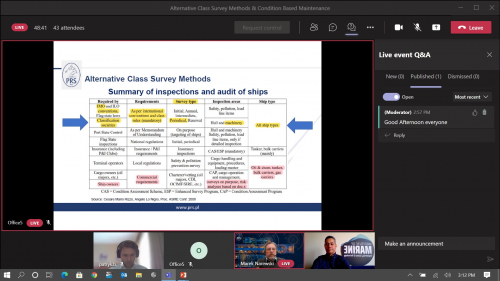
Alternative Class Survey Methods and Condition Based Maintenance, to reduce OPEX and manage risks, were the compelling topics under discussion with 80 members of the global shipping industry, who attended a superlative IMarEST UAE branch technical webinar. Polish Register of Shipping and Info Marine Middle East presented these approaches that fortify vessel life cycle management, strengthening business performance.
Marek Narewski, Expert Engineer and Technical Specialist, from the Gdańsk headquarters of Polish Register of Shipping, justified the requirements for performing Alternative Surveys of machinery onboard, per Class rules, harnessing the full potential of assets and operations. He highlighted the appropriate balance that class societies maintain, in ensuring that ship owners comply with IMO regulations, while still being empathetic to the fact that ships need to operate profitably. Marek identified the primary causes of machinery failure which served as the backdrop of Condition Maintenance and is referred to in the PRS Rules & IACS standards relating to Condition Monitoring (CM) and Condition-Based Maintenance (CBM) schemes. That set the stage for Patryk Brząkała, Senior Reliability Engineer, Info Marine Middle East to present the practicalities & benefits of the CBM strategy.
Patryk defined Condition Monitoring (CM) as the acquisition and processing of data that indicates the state of ship machinery over time whereas Condition Based Maintenance is maintenance performed as governed by CM programs. He underlined the different maintenance strategies & stressed on the reasons to consider CBM, a key driver being costs reduction, while concurrently managing risk. He very aptly put into perspective Condition Monitoring’s philosophy of not repairing damaged equipment, but rather preventing it from being damaged. This is achieved when CM smartly guides the marine engineer identifying which machinery needs to be attended & to know which specific parts need to be repaired, without the cumbersome need to dismantle equipment. Patryk indicated that a better result can be expected if processes are adapted differently, and commensurate with the topic, if tried & tested contemporary technologies are followed. To establish the reality on the ground, he explained the unique nature of CBM measurements onboard & the need for good cooperation with the ships engineers to derive realistic conditions of machinery operation. Due to space constraints, machinery onboard is installed with minimal footprints in a compact area and sometimes with no real stiff foundations leading to measurements being vulnerable to environment influences. It is therefore necessary to have specialists capable of filtering out the ‘NOISE’ e.g. the M/E influence which is transmitted thru the ship’s steel structure to other machinery can have an effect on vibration readings.
During these challenging times of the pandemic, remote CBM is becoming increasingly important as Patryk emphasized, providing Info Marine with crucial data that helps them develop reports with Technical advice & solutions, based on which class societies may permit greater TBO obviating superfluous equipment downtime and reducing ships’ operational costs.
Nikeel Idnani, Honorary Secretary of the IMarEST UAE branch who moderated the engaging webinar, shared his hands-on experience with traditional planned maintenance based upon predefined scheduled intervals stipulated by the engine manufacturer and a specific case during which human error resulted in downtime for his ship and a hefty bill. On the other hand, CBM leverages on accredited tools that provide visibility into equipment health, allowing identification in real time and prompt action on degrading conditions leading to safer, more reliable and competitive operation of maritime assets. Nikeel referred to: ‘Smart predictive maintenance solutions which achieve operational efficiency of increasingly complex modern machinery is becoming a reality, shaping the next generation of maintenance methodologies propelling maritime safety in a digital era’.
View the video recording: Replay Link