Diversity is more than just virtue signalling or a tick-box exercise
This International Day for Women in Maritime, Captain Ann Pletschke shares her personal take about gender and equality in the sector.
Diversity can often be seen as a divisive word, one that can create as many barriers as it seeks to remove. 2026 sees the 4th International Day for Women in Maritime, and I’ll admit it was a ‘day’ I was against at its inception. Four years on, I do see merits in a focused annual opportunity to highlight the role of women within our industry – the challenges, but also the opportunities that a diverse and representative workforce brings, not only for women but for maritime as a whole.
For me, diversity is not about labels or visibility; it is about capability, safety, and enabling all seafarers to perform at their best.
What I do not want to see is a day where women preach to fellow women, and where “old boys clubs” are replaced with “old girls clubs”. I went to sea long before we had hashtags, social media and the term ‘shefarer’. #WomenInMaritime wasn’t a thing – and I’m glad of that.
I’ve had some pretty immense challenges because of my gender over the decades, and often felt like a different, and at times, maligned outsider – from my first trip as a cadet through to the lofty heights of wearing 4 stripes. Some of those challenges could be reframed as discrimination and gender-based violence.
And yet, I’m glad there wasn’t a hashtag. I stepped onto gangways then, as I still do now, as a fellow seafarer. I wanted to be treated as an equal – not as something different, not as less capable or as an objectified colleague but simply as a seafarer. This lies at the heart of my reticent hesitation about embracing “Women in Maritime Day”.
There is, of course, a reality that women do have physical and biological differences compared to men. Women have proven through the years that gender being a barrier to being a successful seafarer is an outdated concept that trailblazers such as Victoria Drummond did so much to disprove.
Over 100 years on from the first female marine engineer, Victoria Drummond, heading to sea, we still are playing ‘catch-up’. Many ships do not routinely have a sanitary bin onboard – whether in a common toilet or cabin. On my last vessel, I was able to get sanitary bins provided, eventually, by shore management due to embarking three female scientists but it caused a stir. Imagine similar hassles in procuring for a shore office? I think not.
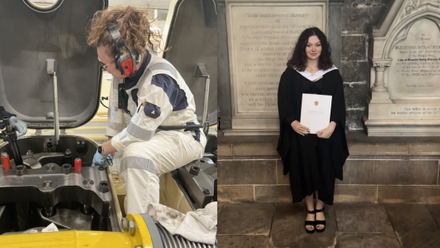
Progress has been made in making PPE available in more shapes and sizes, which not only benefits women but men also. I’ve sailed with many men over the years shorter than my 1.55m frame who also cut the legs and arms of coveralls to trim them down. Like PPE, ship design and ship systems need to be suitable for everybody. I struggled on my last ship to access certain equipment as it was placed too high to reach the buttons, even on tip-toes. My back-to-back colleague, male, also couldn’t reach the same buttons, being little over 1.60m himself.
This again shows considering diversity is not a “women problem” but an “everyone problem”. When viewed through a human-centred deign lens, these are all not merely issues of comfort, but matters of access, usability and safety.
Creating a diversity-friendly maritime environment that is inclusive and tolerant aids more than just minorities. A tolerant workplace with strong culture and policies in action, not just on a bulkhead, is a psychologically safe workplace where people are free to speak up and raise concerns.
Parental leave policies benefit male seafarers who want to spend time with a new family addition as well as female seafarers. I’ve sailed with many male colleagues who would welcome the opportunity on regular rotation to job-share working every-other rotation to have a better work/life balance.
Such policies can benefit parents wanting to spend more time with children, whether male or female parents, seafarers who have caring responsibilities or even those who want more time for studies, hobbies or other interests. USV operations from remote onshore centres are giving seafarers the opportunity to continue working later into pregnancy or whilst breastfeeding but also in case of medical challenges to access regular appointments or care for loved ones whilst still using their engineering or bridge watchkeeping skills.
Diversity means so much more than gender or race. I’ve sailed with seafarers who have various neurodiverse strengths – in fact, one of the best captains I ever sailed with in terms of seamanship ability was dyslexic. One of the most knowledgeable benthic scientists I sailed with was on the autism spectrum. We need to celebrate diversity in all its forms and identify the strengths a diverse workforce brings to our ships, and our industry.
Therefore, on this Women in Maritime Day, I recognise and celebrate the progress made towards a safer, more tolerant and more inclusive industry – not only for women but for everyone who works at sea. Reflecting on pioneers such as Victoria Drummond, and the many women since whom I and many others look up to, who have forged long and successful careers at sea despite experiencing personal and institutional discrimination, sexual assault and misogyny, we are reminded that diversity is a strength, not a weakness in our profession.
If Women in Maritime Day is to have lasting value, it must move beyond visibility to meaningful impact – driving improvements in design, policy and culture that enhance safety, capability and wellbeing for all. That is a legacy I would wholeheartedly endorse as, I believe, would many of those who came before me.