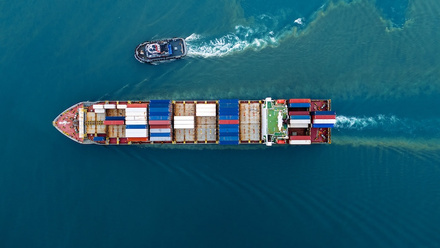
Generative AI and how it is changing ship design
A new project will use AI to help plan maritime vessels, but what are the advantages and limitations?
A leading specialist in robotic 3D printing systems is spearheading the manufacturing element of a new £700,000 project to transform maritime vessel design and production. This new project claims to accelerate design cycles by 20%, cut design costs by 10%, and increase efficiency by 50%.
GenDSOM was conceived in preparation for the Clean Maritime Demonstration Competition. It brings together a UK consortium led by Compute Maritime with design, simulation, manufacturing and university partners. Rapid Fusion, in conjunction with Compute Maritime and consortium partners BYD Naval Architects, Siemens Digital Industries Software and the University of Southampton, will work on the initiative.
“The project was developed in response to the growing need to accelerate low-emission vessel design and to remove bottlenecks in the current design and simulation pipeline,” explains Shahroz Khan, CEO, Compute Maritime. “Traditional workflows focus on modifying known hull forms, which can limit innovation. This aims to enable the rapid creation and evaluation of novel vessel geometries while ensuring they can be built and operated effectively.”
The GenDSOM project aims to integrate generative AI – technology that creates content through deep learning – with simulation and manufacturing from the earliest design stage. This allows many validated design options to be explored at high speed.
Khan comments: “Anticipated benefits include faster development cycles, reduced redesign loops, improved fuel and emissions performance and the ability to produce geometry that is feasible to manufacture, particularly using large-format additive manufacturing. The approach seeks to deliver both environmental and cost advantages over a vessel’s lifetime.”
A number of challenges
While using generative AI can have its benefits for ship design, there are still challenges. “Ship design requires precise, physically valid geometry, so models must incorporate hydrodynamic, structural and regulatory considerations,” Khan states. “High-fidelity simulation is computationally expensive, so a balance between data-driven models and targeted physics simulation is required. Manufacturing also places real constraints on what can be built in practice.”
Another key challenge is ensuring meaningful collaboration between AI systems and naval architects, since expert judgement remains central to safe and effective vessel design.
While Khan says that generative AI will increasingly shape the early stages of design, helping to explore performance trade-offs and identify strong candidate solutions more quickly than traditional workflows, this will not replace human designers.
“Instead, the role of the naval architect shifts to guiding the models, applying judgement and ensuring safety, compliance and practical buildability. [Our system] is based on partnership between human expertise and advanced computational tools, rather than automation that removes human input.”
Khan's comments echo the findings of a recent research project that considered the part that AI can play in ship design. Specialist marine engineering consultancy Longitude led the project which also included members from the University of Birmingham, Chartwell Marine and DNV, among others.
In conjunction with the University of Birmingham, Longitude tested an AI tool's knowledge of ship design and alternative fuels for variables including weight, space, and regulatory constraints.
While the findings of this experiment found that shipbuilding can benefit from AI, there were also limitations. The report said that the AI tool needs, “to become an in-house piece of software that naval architects can use directly themselves.” Another factor in the report was the training of the AI tool, which would need, “a lot of input from naval architects and equipment vendors.”
Richard Featherstone, Head of Design Engineering at Longitude, explained that the AI study shows that: “AI tools can assess multiple objective functions far quicker than a human with conventional design tools.
“However, training the AI requires a large amount of input from naval architects and equipment vendors. With a fully trained tool, removing repetitive iterative calculations will allow naval architects time for greater creativity.”
Tell us what you think about this article by joining the discussion on IMarEST Connect.
Image: concept of generative AI in action. Credit: Compute Maritime.