Vessel blackout leads to Singapore’s worst oil spill in a decade
While departing the Port of Singapore, Vox Maxima experienced a loss of electrical power, hit the stationary bunker tanker, Marine Honour, and leaked an estimated 400 tonnes of oil into the surrounding water.
When blackouts on ships occur – especially while on open sea and quickly rectified – the crew and their employers do not always report power outages or loss-of-propulsion (LOP) incidences, unless they sadly end in an accident. There is, therefore, not a surfeit of data available; however, what there is implies that such incidences are worryingly common in the shipping industry.
Between 2005 and 2024, the classification society American Bureau of Shipping (ABS) demonstrated a rising trend in the rate of reported blackouts in the world maritime fleet.
One of the most famous examples is that of MV Dali, which suffered a sequence of outages as it neared the Francis Scott Key Bridge, in Baltimore, with tragic consequences and a loss of six workers in March 2024.
And in June 2024, a further example of a situation where a loss of propulsion led to a damaging outcome unfolded at the Port of Singapore, when the Dutch-flagged trailing suction hopper dredger Vox Maxima suffered a catastrophic loss of electrical power, ultimately ending up involved in Singapore’s worst oil spill in a decade.
How 14 June unfolded
On Friday morning, duty engineers working on the 29,920gt dredger Vox Maxima opened two starboard circuit breakers to inspect cooling fans on a starboard transformer. The breakers were left open following miscommunication. Early in the afternoon, the vessel was due to depart from the Western Working anchorage en route to ST Engineering Marine shipyard. The vessel would be under the conduct of local harbour pilots.
The crew switched the vessel’s main power from its auxiliary generator to its main generators to prepare for the journey. But unbeknownst to them, a critical circuit breaker was still open, and only one generator, on the port side, was supplying electrical power.
As the vessel’s two hydraulic power units started to draw power, its port side circuit breaker overloaded. The dredger experienced a complete loss of electrical power to its low-voltage systems, resulting in a loss of control over its propulsion and steering systems, with the rudder stuck at 10 degrees to starboard.
The vessel was now Not Under Command (NUC) as it continued to head northward at a speed of 8.3 knots, with engines stuck at half-ahead. Crew attempted to weigh anchor, to slow the vessel’s rate of advance, but neither the vessel’s port nor starboard anchors respond to the crew’s input.
One, it transpired, was physically wedged in the hawse pipe, unable to move; and the starboard anchor, though free, could not be released because the power outage had also put the windlass and hydraulics out of commission.
Veering across the port, the vessel struck the starboard side of Singapore-flagged product tanker Marine Honour, as it was berthed alongside container ship Ever Blink. Pinned against the other vessel, Marine Honour had nowhere to go as at 14:20 the dredger’s bow struck its starboard side, smashing a hole in its hull and ripping open ten of its cargo tanks, six ballast tanks, and a slop tank.
The cargo of fuel, some 400 tonnes according to estimates, disgorged into the waters around the Pasir Panjang terminal.
According to multiple reports, the Maritime and Port Authority of Singapore (MPA) acted swiftly, mobilising craft to mitigate the environmental impact. Fortunately, the allision itself did not cause any injuries.
Over a dozen response vessels were engaged on the day, and as bunker fuel escaped into the sea and spread along nearby shorelines, it eventually reached the East Coast Park, Labrador Nature Reserve, Sentosa, and the Malaysian coast. Numerous agencies were coordinated and continued to monitor and treat residual slicks over the course of the coming months.
The lessons learned
The absence of a structured handover process and formal task recording meant that critical information about the state of the electrical distribution system was not effectively communicated between shifts, the investigation by the Transport Safety Investigation Bureau (TSIB) found.
As such, the TSIB report included recommendations for the vessel managing company to improve handover procedures, formalise task recording, enhance electrical maintenance routines, and ensure systems such as anchor release mechanisms are readily operational.
Van Oord, the Netherlands-based company that manages Vox Maxima, issued a circular to other vessels in its fleet, highlighting the importance of emergency preparedness.
They also developed a checklist for electrical failure testing and recovery and mandated an annual drill for electrical failure across its vessels.
Following the incident, four of Vox Maxima’s crew were fined between SG20,000 and SGD40,000 for failing to discharge their duties properly.
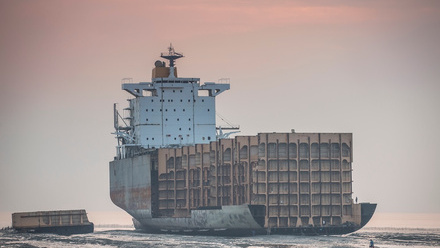
Image: Vox Maxima dredging along the Dutch coast before the accident. Credit: Shutterstock.
Tell us what you think about this article by joining the discussion on IMarEST Connect.