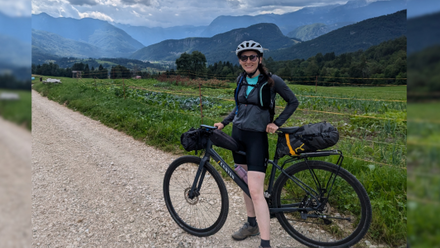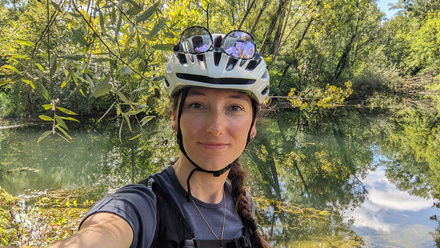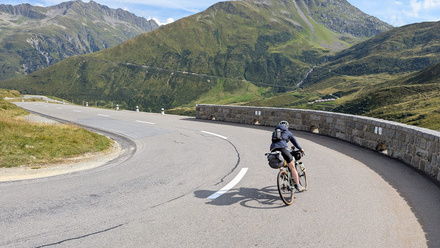
In September 2024, Hannah Muir, a marine researcher, set off on a journey cycling down the Rhine River to learn from locals about their connection to the river and how they’re helping to restore and protect their water system.
Hannah’s goal was to learn about how positive actions on the river can benefit our oceans. In this nine-part series, Hannah interviews experts along the Rhine, exploring what motivates people to protect these systems and to hear about their vision for the river’s future.
This film showcases some of the people and projects trying to improve the quality of the Rhine River for the benefit of society and nature, exploring the motivations and visions of the people driving this change.
This journey was funded by the David Henderson Inspiring Journey Grant.
Episode 1: Introduction to the journey
Episode 2: International Commission for the Protection of the Rhine
900km into the journey, Hannah meets Daniel Heintz, the Executive Secretary at the International Commission for the Protection of the Rhine (ICPR), based in Koblenz, Germany. In this episode, they discuss how the ICPR facilitates cooperation between the nine states in the Rhine watershed, and how fish migration demonstrates the connection between river health and ocean health.
Episode 3: Salmon Comeback Project
440km into the journey, Hannah meets Ruedi Bösiger, who leads River Restoration & Conservation for the World Wide Fund for Nature (WWF) in Switzerland. Ruedi leads the Salmon Comeback Project, an interesting example of holistic river management from Switzerland all the way to the Netherlands. Hannah and Ruedi discuss how, through sharing knowledge between projects across the globe, we can move towards holistic water management.
Episode 4: Haringvliet Dam
At the end of Hannah’s 1,400 km journey along the Rhine River, Hannah meets Niels Kuiken, who manages the maintenance of the Haringvlietsluices in the Netherlands, to find out about how fish migration can be supported in the Rhine–Meuse–Scheldt delta, where the Rhine River enters the North Sea.
Episode 5: Rohrschollen Island Nature Reserve
570 km into the journey, Hannah reaches the City of Strasbourg, where she meets Dr David Eschbach, project manager of alluvial functionality at the Rohrschollen Island Nature Reserve (RINR). Sections of the Rhine River have been straightened for inland shipping, and artificial dams for hydroelectric power generation have been placed across the river. This has had a significant detrimental impact on the natural flow and sedimentation processes in the rivers, causing loss of ecosystems that once supported biodiversity along the river. They discuss how initiatives such as the RINR help to mitigate these issues.
Episode 6: Local businesses
800 km into the journey, Hannah detours away from the Rhine River towards the hillsides surrounding the Selz River, a tributary of the Rhine in Germany's largest wine region, Rheinhessen, meeting Hanneke Schönhals, a small-scale wine maker. For Hanneke, wine production is about much more than the product: it’s about working with nature, sharing lessons passed down through generations of living on the land, and understanding the connectivity of all systems on earth.
Episode 7: RhineCleanUp
1000 km into the cycle, Hannah meets Christian Stock in Cologne, the co-organiser of Germany’s largest RhineCleanUp, during their biggest day of action on the Rhine. The RhineCleanUp is a coordinated action across the Rhine River and its tributaries that brings together people from all of society to do their bit for the river and ocean.
Episode 8: Challenges ahead
When Hannah stopped in Koblenz, Germany, 900km into the journey to chat with Marc Daniel Heintz from the ICPR in Episode 2, they also discussed some of the greatest challenges facing our global water system. They discuss working with our rivers and seas, giving nature space to thrive, and respecting the interconnectedness of all life on earth.
Episode 9: A vision for the future
Concluding this nine-part series, Hannah explores what true restoration means: working with nature to find solutions that enable natural processes to reestablish, and restoring our connection with natural systems by relearning our connection to them and their connection to each other.