Demolition Wallet: a potential breakthrough in sustainable ship recycling
Critical ship documentation is often lost long before a vessel reaches the recycling yard, making safe and efficient dismantling harder than it needs to be. A Demolition Wallet could preserve the information recyclers need to support safer engineering decisions and more responsible end-of-life ship management.
Ship recycling is far more than cutting steel; it is an art of engineering that demands precision, planning, and a systematic approach. In many respects, ship recycling is the reverse process of shipbuilding. Just as a vessel is constructed in a carefully planned sequence, its dismantling also requires a methodical and well-engineered process to ensure safety, environmental protection, and operational efficiency.
Having worked for several years as a Ship Recycling Consultant, designing Ship Recycling Facility Plans (SRFPs) and demolition process flows, I have observed that one of the greatest challenges in preparing a Ship Recycling Plan (SRP) is the lack of essential ship documentation.
The Hong Kong International Convention for the Safe and Environmentally Sound Recycling of Ships (HKC) and IMO Resolution MEPC.196(62) require that a ship-specific Ship Recycling Plan be prepared and approved by the competent authority before recycling begins. The plan must consider numerous critical elements, including pre-arrival information, the updated Inventory of Hazardous Materials (IHM), hazardous waste management procedures, safe-for-entry and safe-for-hot-work planning, and a detailed dismantling sequence.
Preparing such a plan depends heavily on the availability of authentic drawings, technical documents, and manufacturers’ manuals. Unfortunately, these documents are often incomplete or entirely unavailable by the time a ship reaches its final voyage.
Throughout its operational life, a ship may travel millions of nautical miles while undergoing multiple changes of crew, management companies, and ownership. During these transitions, operational manuals are generally preserved because they are essential for daily operations. However, original construction drawings and production documents are frequently neglected, misplaced, or lost. Based on my practical experience in ship demolition, obtaining the necessary documentation from a recycling-bound vessel is often a significant challenge.
IMO Resolution MEPC.196(62) identifies several important documents that support the preparation of an effective Ship Recycling Plan. These include the General Arrangement Plan, Capacity Plan, Shell Expansion Plan, Fire Control Plan, Trim and Stability Calculations, and Lightweight Distribution or Calculation Tables. Additional useful references include the Midship Section, Construction Profile, Longitudinal and Transverse Bulkhead Sections, Fore and Aft Construction Drawings, Superstructure Plans, Accommodation Plans, Hydrostatic Curves or Tables, Deck Piping Systems, Ventilation Arrangements, Painting Schemes, Joiner Works, Engine Room Arrangements, Bilge Piping Systems, Pump Room Arrangements, Ballast and Cargo Piping Diagrams, and manufacturers’ finished drawings of major equipment.
Alongside these technical documents, an updated Inventory of Hazardous Materials (IHM), the International Ready for Recycling Certificate (IRRC), and, where applicable, the Declaration of Acceptance of Ship Recycling (DASR) should also be readily available to the recycling facility.
The Demolition Wallet
To address this longstanding problem, I propose introducing a Demolition Wallet (DW) - a standardised repository maintained on every vessel of 500 GT and above. It would contain both digital copies, securely stored in an electronic folder, and hard copies preserved in a designated lockable storage cabinet on board. A standardised checklist of required documents would be periodically updated, verified, and endorsed by the Flag State Administration or its recognised organisation before the vessel proceeds for recycling.
The concept should not be limited only to ships flying the flags of Parties to the Hong Kong Convention or vessels subject to the European Union Ship Recycling Regulation. Instead, it should be universally applicable to all commercial ships intended for recycling, regardless of flag or jurisdiction.
The benefits would be substantial. Ship recyclers would gain immediate access to reliable information necessary for preparing accurate dismantling sequences and safe operational procedures. Hazardous material identification would become more efficient, engineering risks could be reduced, project planning would improve, and regulatory compliance would be strengthened. Most importantly, worker safety and environmental protection would be significantly enhanced.
The maritime industry has invested considerable effort in improving sustainable ship recycling through regulations and technical standards. However, the simple challenge of preserving critical ship documentation remains largely overlooked.
A standardised Demolition Wallet could bridge this gap. It represents a practical, low-cost, and highly effective solution that would support safer engineering decisions and more responsible end-of-life ship management.
In the pursuit of sustainable and environmentally sound ship recycling, the Demolition Wallet has the potential to become a transformative innovation for the global maritime industry.
Tell us what you think about this article by joining the discussion on IMarEST Connect.
Main image: Partially broken down ship in ship breaking yard in Chittagong Bangladesh. Credit: Shutterstock
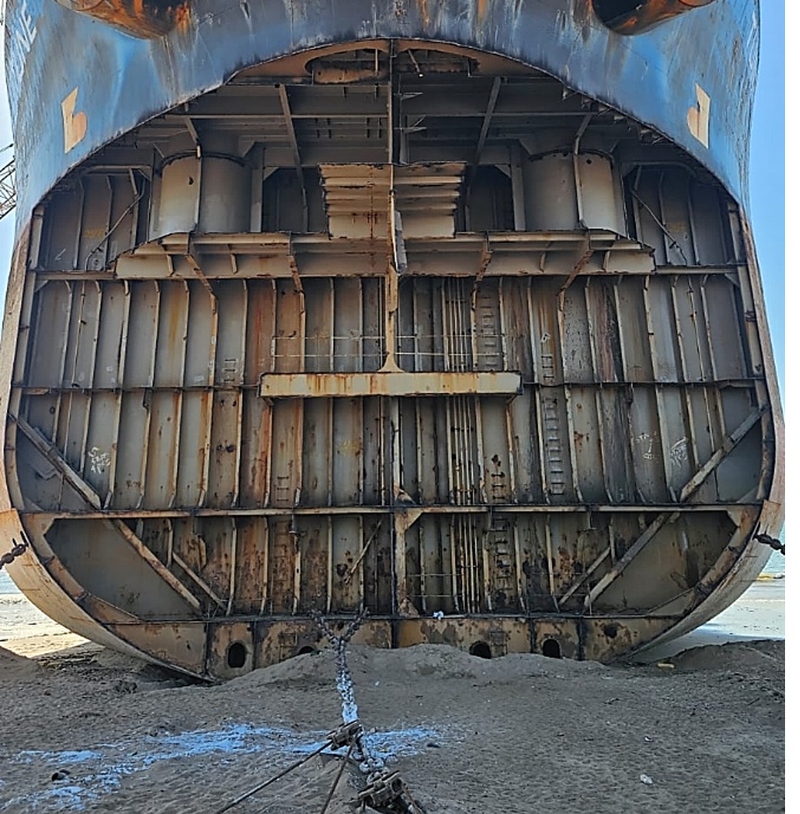
Inline Image: Ship recycling in action. Credit: Mohammad Mahbubur Rahman