When starting air turns explosive
A partially open air start valve helped created the conditions for an explosion while the CMA CGM Shanghai was preparing to berth
The starting air system is a critical component of a diesel engine. A burst of compressed air provides sufficient force to power the first stroke of the piston; after the crankshaft begins to turn and there is enough momentum to begin the diesel cycle, and the starting air system is cut off.
In a two-stroke marine diesel engine, this process is massive. Ideally, a ship engine would run constantly at around 80% load, the efficiency sweet-spot where combustion is healthiest, and unburned by-products are minimised or eliminated. But the power output of the engine is linked to ship operation. Very large cargo ships on port manoeuvres is ungainly, like an aircraft on land; built in every respect for smooth operation in open sea, it will call on its engine to operate in a mode for which it is poorly optimised. Its funnel may be seen emitting incompletely-combusted fuel in the form of black smoke; higher vibrations can cause increased wear on componentry.
And, in rare cases, such as the topic of today’s Troublespot, it may result in a highly dangerous explosion.
What happened
After an 11-day voyage from Karachi, the containership CMA CGM Shanghai arrived at the port of Singapore in the early hours of 15 March 2025. A pilot boarded at 6.12am, ready to guide the vessel in. Preparation for berthing proceeded normally. By 7.00am, the crew was called to standby in preparation for berthing and mooring. Tugs were secured at the forward and aft ends, and at 7.42am, the pilot ordered ‘dead slow ahead’ on the main engine, requiring the vessel’s engine to operate at its lowest-possible load setting.
The chief mate moved to the port wing telegraph to execute the order but at that moment, a loud explosion was heard from the aft section of the accommodation block. Crew saw smoke emerging from the area as alarms immediately activated throughout the vessel. The water-mist system began to cloud the engine room in a curtain of spray.
Although the engine telegraph was returned to the stop position, the bridge team quickly noticed a loss of control air pressure. The chief engineer, who was in the engine control room, reported significant technical problems with the main engine but confirmed there was no fire in the machinery space.
A preliminary inspection by the chief engineer revealed an explosion inside part of the main engine starting air pipe. Three starting air valves were found with damaged compressed springs. The inlet pipe to the main starting air valve had exploded, including various 90° bends, suggesting localised overpressure or stress concentration. The main starting air valve itself sustained damages, and the end flange of the main starting airline was blown off due to the force of the blast. Every burst disc within the system had ruptured and the blast wave and exploding debris had caused secondary damage across the engine room.
Unable to rely on the vessel’s own propulsion during a critical phase of the manoeuvre, the ship’s Master and pilot requested additional tug assistance. With their help, the ship eventually berthed safely later that morning.
Findings
Investigators concluded the probable cause of the explosion was caused by a stuck starting-air valve on the cylinder head, which remained partially open, combined with the presence of lubricating oil, soot, or unburned fuel within the air-start system. Records showed that the main engine had been started three times in succession, calling on repeatedly charges of compressed air from the air-start system. On the third and final start, the pressure drop was not recovered.
Hot lubricating oil admitted to the starting-air systems could create carbon deposits, leading to ignition. But investigators found little evidence of excessive oil carry-over: the system was fitted with automatic drains, compressor inspections found wear within acceptable limits, and lubricating-oil consumption records did not indicate abnormal conditions. Though oil contamination is impossible to rule out completely, then, it was considered insufficient to explain the casualty.
In its report, Transport Malta supposed that combustion byproduct gases – containing unburned fuel, soot, or oil mist – may have been pushed through the partially-open air-start valve and into the air-start system during the high-pressure power stroke, creating a direct path between the engine cylinder and the air-start manifold. Rapid pressure rise and shock loading can rupture pipework, burst discs and valve components in quick succession, creating “a significant risk of backfire or detonation,” via a “single hot spot or spark” that could “trigger an explosion within the manifold” consistent with the widespread mechanical damage found on CMA CGM Shanghai.
The vessel was fortunate in several respects. Given heat, fuel and a pathway into the manifold, the same forces used to get a piston moving caused the air-start system to become one of the most destructive forces in the engine room. But this explosion did not develop into a fire; no one was injured, with no personnel working in the immediate vicinity of the failed components; and the casualty occurred at such a time as tug assistance was on-hand to provide propulsion. Under different circumstances, the outcome could have been significantly more serious.
Tell us what you think about this article by joining the discussion on IMarEST Connect.
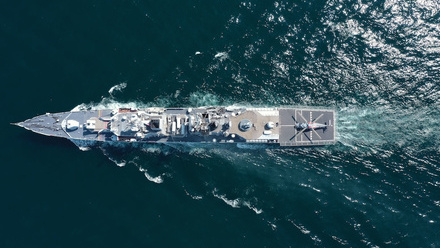
Image: Aerial view of container ship and tug. Credit: Shutterstock