The True Cost of Hull Biofouling: Fuel, Time and Carbon Penalties
Hull biofouling comes with financial and environmental costs that the industry can’t afford to ignore
As a main pillar of the global economy, the shipping industry contributes about three per cent of global carbon emissions, and it is under ever-growing pressure to become net-zero. Many shipping segments are striving to decarbonise, whether this means revolutionary fuels, costly technical advancements like Hull Air Lubrication System, Engine Power Limitation (EPL) and propeller and rudder optimisation. Governments are encouraging change by introducing complex carbon tax schemes like the European Trading System (EU ETS), MARPOL regulations such as the Carbon Intensity Indicator (CII) grading system, and, from January 2025, the FuelEU Maritime Regulation, compelling vessel owners and operators to reduce Greenhouse Gas (GHG) emissions through both absolute emissions pricing and energy-intensity limits.
The outcomes of all these efforts can be substantially neutralized by a less conspicuous yet significant factor influencing emissions - biofouling or hull fouling. This happens gradually when ships are at port or idle. Marine organisms, such as algae, barnacles, and mussels, attach to submerged surfaces of vessels, increasing hydrodynamic resistance to generate a drag effect, which degrades vessel performance and fuel efficiency and results in higher GHG emissions. In the context of the IMO’s CII and the EU ETS, addressing biofouling presents both challenges and opportunities for vessel operators.
Biofouling impact on fuel efficiency
The increased drag disrupts the smooth flow of water along the hull, leading to greater water resistance. The correlation between biofouling and fuel consumption is direct: the greater the friction, the more power is required to propel the vessel, leading to higher fuel usage. Amongst others, periodic under water cleaning is the most practical way to circumvent this issue as a clean hull can improve fuel efficiency by up to 40 per cent, depending on the severity of the biofouling.
Vessel owners and operators are usually left with a costly dilemma of either taking on consequences of late arrivals or increasing fuel consumption even further by speeding up the vessel to keep the initially planned ETA. A dry-bulk Capesize vessel free from biofouling would on average take 70 days to complete a conventional China-Brazil-China round voyage, consuming an assumed warranted 40 tonnes of heavy fuel per day depending on the ship. Performing the same voyage in fouled condition, presuming a mere and conservative five per cent effect on performance (or more depending how severe fouling is), will add four days to the voyage, increasing total consumption by 160 tonnes. The additional days can be mitigated by increasing the ordered speed but that also increases daily consumption.
The impact of poor performance: CII, EU ETS & FuelEU Maritime
As these frameworks incentivise shipowners and operators to adopt measures that enhance efficiency and reduce emissions through a market-based approach, FuelEU Maritime further tightens compliance by directly regulating the greenhouse-gas intensity of energy type used onboard on a well-to-wake basis. This means that excess fuel consumption caused by hull fouling now results in both higher emissions exposure and worsening energy-intensity performance. Poor management of biofouling has substantial impact on CII ratings and the additional voyage costs in EU ETS. CII assesses a vessel's operational efficiency by grading an individual vessel from A to E based on operational efficiency, measured in grams of CO₂ emitted per deadweight ton-nautical mile (g CO₂/dwt-nm), whilst EU ETS requires ship owners and operators to purchase “allowances” for their CO₂ emissions. In December 2025 the cost of a ton of generated carbon emitted peaked at around US$90.
The true cost of biofouling
Given the above example where a fouled ship consumes an additional 160 tonnes of marine heavy fuel on a particular voyage, and given that a ton of heavy fuel in Singapore averaged US$500 across 2025, this amounts to an additional cost of US$80,000 on fuel alone. The additional four days comes at an average of US$40,000 a day in hire, or $160,000 in total. Considering that a tonne of heavy fuel oil generates about 3.15 tonnes of Emitted Carbon, the additional 160 tonnes consumed translates into 504 tonnes of emitted carbon, resulting in an additional US$45,300 in carbon allowances to comply with EU ETS. Adding additional fuel, time and EU ETS allowances we come to staggering total of US$285,300 as a result of the alleged five per cent effect on performance, with a potential increase up to 40 per cent depending on fouling severity.
It’s worth mentioning that the most reactive way of mitigating this issue is by performing an underwater hull, rudder & propeller cleaning prior to departure, which would come at a cost of between US$15,000 and US$30,000 for the Capesize bulker in question, in either Brazil, Singapore or China.
Notwithstanding vessel owner’s losses, the brunt of these preventable costs is reflected on the end-product prices paid for by consumers, and even greater costs to the planet in the form of preventable emissions contributing to global warming. Under FuelEU Maritime, increased fuel consumption resulting from biofouling can adversely affect a vessel’s attained GHG intensity of energy used on board and, consequently, its compliance balance. Where the attained GHG intensity exceeds the applicable regulatory limit, a compliance deficit may arise, potentially resulting in a FuelEU penalty unless mitigated through available flexibility mechanisms.
Given the costs, why isn’t biofouling a shipowner priority?
There are several ways and strategies to manage biofouling properly - regular and preventive hull cleaning and maintenance, advanced antifouling coatings/paints that retard fouling build-up, Automated Cleaning Remotely Operated Vessels (ROV) and the traditional divers in the water.
Too often, however, fouling falls through the cracks, inhibited by environmental rules or biosecurity, contract-based disagreements on who is liable for it, supported by grey areas and loopholes of charter party clauses. This is an area of the ship's maintenance that is often overlooked by vessel owners and their technical managers, who in most cases are not the party paying for the additional fuel consumption and emissions. For instance, a standard BIMCO Speed & Consumption (S&C) warranties clause often applicable on Charter Parties, stipulates a threshold of plus or minus five per cent on S&C warranties, meaning that over-consumption up to five per cent can’t be claimed by operators or charterers and it is often disregarded as it falls within the clause’s provision.
Another example is the common Hull Fouling clause widely used on Charter Parties, which states that if, for example, a vessel remains idle or at port over 25 days, S&C warranties are suspended until cleaning is performed. This forces charterers to arrange cleaning in order to re-instate fuel consumption warranties. These clauses are not always efficient and often open to interpretation.
As fouling builds up gradually, if a vessel had multiple stays of 20 days at ports, owners will only be obliged to perform hull cleaning once the vessel is underperforming over five per cent as per S&C warranties, resulting in neither party taking action to reduce additional consumption and disregarding the importance of mitigating GHG emissions.
There are, of course, proactive operators which keep hull fouling in check: these companies have designated departments to keep hull maintenance and performance at its best by monitoring anti-fouling coating conditions and regular cleanings.
Regular cleaning and maintenance
Maintaining a clean hull through regular cleaning is the most straightforward approach to managing biofouling. Hull cleaning is not always allowed due to some countries’ strict biosecurity regulations, as in-water cleaning can potentially release aquatic species, pathogens and toxicants, impacting the marine environment. Hull cleaning can also be deferred due to a vessel being on a tight schedule, costing owners more to stop the vessel for a day or two for cleaning than the additional consumption costs: on LNG tankers, for example, the daily charter can be more than US$100,000 and spike at US$240,000 per day.
Other options include using a top-quality anti-fouling coating. This is still the most efficient and proactive approach, with some substantial advancements in anti-fouling paint efficiency and durability over the years. It does, however, inevitably wear off gradually over time, some faster than others depending on quality and exposure to fouling.
Conclusion
Reducing biofouling not only enhances fuel efficiency but also aligns with broader economic and environmental objectives. As regulatory frameworks like CII and ETS increasingly influence maritime operations, by adopting regular maintenance practices, advanced coatings, and emerging technologies, complemented by comprehensive Charter-Party clauses and contract agreement, the maritime industry can significantly shorten the route towards a more sustainable and net-zero future.
Tell us what you think about this article by joining the discussion on IMarEST Connect.
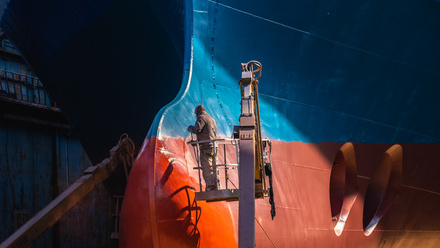
Image: Ship hull, Spain. Credit: Shutterstock