Clearing the air: why NOx rules need modernising
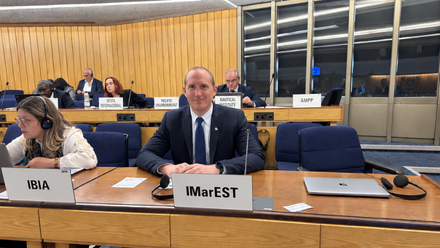
Nitrogen Oxides (NOx) are a risk to human health, the built environment and a source of acidification. As the lead for the IMarEST delegation on NOx at the International Maritime Organization (IMO), Andy Wright explains how the Institute is ensuring that air pollution regulation keeps pace with evolving fuels and today’s engine technologies.
NOx is produced whenever fuel burns at high temperatures, particularly in ships’ engines. NOx emission limits are agreed by the IMO and governed using the mandatory NOx Technical Code (NTC). Unfortunately, the subject has attracted far less attention in recent years than it deserves, overshadowed first by the introduction of the fuel oil 0.50% sulphur limit and more recently by the development of the IMO’s Net Zero Framework.
Yet, important work on the regulation of NOx has continued in the background, There have been no great fanfares, but the IMarEST has been one of the principal architects of modernising emission test requirements, ensuring that they are effective for today’s engines in real world operation, and adapting them for the alternative fuels that will be needed to meet the IMO’s climate change objectives.
Bringing NTC up to date
One of the big issues is that marine engine technology has moved on significantly since the original NTC, or even the 2005 revised version. were adopted. However, the NTC has remained rooted in assumptions that engines were mechanically controlled and ran solely on petroleum-derived distillate or residual fuels.
To that end, the IMarEST has been closely collaborating with a number of the Member States and other Observer Organizations to bring the NTC into the modern era and to set it up for the future.
A rational emission control strategy
The first set of amendment proposals submitted to the IMO, in which IMarEST was heavily involved, covered the definition of a rational emission control strategy (RECS) and how that was to be demonstrated as part of an engine’s NOx certification process. In essence, this ensures that an engine’s emissions during testing reflect how it behaves in real life across the whole of its operating range.
The rise of electronically controlled engines created new possibilities for non-linear and selectable adjustments that can fundamentally and readily change how an engine behaves at different speeds and loads. This is a big difference from older engines, which used fixed profile mechanical parts, such as camshafts, to control how they operated, greatly limiting how much they could vary in terms of NOx performance.
The amendments to address this challenge were adopted and will come into force between 2028 and 2030. The NTC will now require that engine builders to declare the allowable operating envelope - the range of speed and power the engine is designed for - above a 25% load. Within the whole of that zone the maximum permitted NOx emissions are set.
Engine Operating Profiles
Alongside this RECS work, the same proposal also addressed the possible misuse of multiple engine operating profiles. Engine operating profiles define the specific load, speed, and environmental conditions an engine experiences over time, crucial for performance optimisation and emissions compliance. These profiles also allow an engine to be optimised for different tasks, such as running efficiently when a ship is carrying cargo versus travelling empty.
Within an engine operating profile there are a combination of settings that affect NOx emissions. These include fuel injection timing and inlet/exhaust valve timing.
In mechanically controlled engines, these settings are largely fixed by engine timing arrangements and cam lobe profiles and hence are difficult to change once the engine is in service. This is not the case for fully electronically controlled engines, where the settings can be optimised for different operating conditions, and with it being readily possible to switch between different operating profiles making it harder to regulate for NOx.
To address this, a ‘composite test’ cycle approach has been created. This approach takes the highest NOx emission value at each test point across all operating profiles and uses these values to determine the certified NOx emission level.
Non-Carbon fuels
Fuels that do not contain carbon, such as ammonia and hydrogen, still result in NOx emissions but they present a particular challenge for regulators when it comes to NOx certification.
Traditionally, certification has relied on the NTC Carbon Balance calculation approach. In simple terms, regulators quantify the NOx emissions using determined exhaust flow rates, an approach which essentially measures the rates of carbon going into an engine as fuel and translate that to an equivalent carbon species exhaust gas rates of equal carbon content. That still works for new carbon-based fuels, such as methanol, ethanol, bio-methane and biodiesel, but not for fuels that contain no carbon at all, such as hydrogen and ammonia¸ or where those are used in conjunction with only small amounts of carbon-based pilot fuel.
To resolve this, the IMarEST helped prepare the proposal, which introduces Hydrogen Balance and Oxygen Balance calculation approaches as alternatives. The submission covering the necessary amendments to the NTC was agreed as the way forward and was approved at MEPC 84 in April 2026 and will now go forward to be considered for adoption at the next session.
NOx Into the future
Despite these advances, the work is not yet complete. Several Member States have raised concerns about whether current NOx certification fully reflects real-world emissions, particularly at engine loads below 25%. This is important because some ships can spend a surprising amount of time operating at low power, especially in port, during manoeuvring, or in dynamic positioning operations. The IMarEST has already materially contributed to this discussion at the IMO.
There are also questions about how to ensure compliance throughout an engine’s service life, especially when after treatment systems such as Selective Catalytic Reduction units are involved, and about the procedures that should apply when control systems fail during operation.
What is certain is that as alternative fuels become more common and engine technologies continue to evolve, NOx regulation must evolve with them. And provide clear direction for engine builders, ship operators and those enforcing the regulations is imperative.
Through detailed technical work and sustained engagement at the IMO, the IMarEST has been instrumental in shaping the systems that will guide the next decades of NOx control at sea. And while much progress has been made, the Institute remains closely involved in ensuring the NTC remains fit for purpose and futureproof. Ultimately, this will lead to cleaner air, improved human health, and reduce shipping’s environmental impact.