Breakwaters: a new design, a new haven for marine life
A new design of breakwater reduces concrete use and increases the substrate area to promote coral and kelp growth
All coastlines are affected by waves and currents that cause erosion; the combination of a storm surge at high tide with additional effects from waves creates the most damaging conditions. The extent and severity of the problem is global, but it differs around the world, so there is no one-size-fits-all solution.
Breakwaters have been successful in reducing the impact of waves and current all around the world. Breakwaters that are made of piles of natural stones or concrete blocks of different shapes and forms, such as tetrapods, are used worldwide.
The breakwaters are placed at a certain distance from the shoreline, which make the incoming waves break and lose a lot of their wave energy. This in turn reduces the wave impact on the beach and reduces natural erosion.
Conventional, standard submerged breakwater
Submerged breakwaters exist around the world’s coast lines and are predominantly of the types shown below.

Figure 1 Picture of submerged breakwaters
These standard breakwaters are suitable for breaking incoming waves, reducing current speed and reducing wave energy impact on the shoreline, in turn reducing the sand erosion on the beach.
Due to the fact that the breakwater is submerged, in time it will become a substrate for marine life (the surface on which an organism such as a plant, fungus, or animal lives).
For a standard breakwater 10 metres long, five metres wide on top and with five metres inclined walls, the total surface area is 150 m2, thus providing 150 m2 of surface upon which coral and kelp can grow. The surfaces are exposed to the waves and the current, which might make it difficult for plankton and small fauna and flora to hang onto for it to later become a larger coral or kelp system.
New type of submerged breakwater
The system is made of a solid base in concrete and with different size hollow tubes sticking out of it. The concrete base provides the submerged stability and the tubes offer protection to fauna and flora against predators, high current and wave flows, enabling the system to become a coral or kelp substrate as well as a protected habitat for fish and other marine life.
This system has the same advantages as the conventional, standard system: it reduces wave energy and current speeds to reduce beach erosion, while promoting the growth of coral reefs, kelps and other marine fauna and flora by increasing the substrate area.
In numbers this translates as follows.
a. Substrate area for a 10 m long system is calculated to be in excess of 600 m2 compared to 150 m2 for a conventional breakwater.
b. Use of rocks and other displaced material = 0
c. Use of concrete is about 15% of that used in a conventional breakwater
d. The tubular members provide a protected substrate inside and outside.
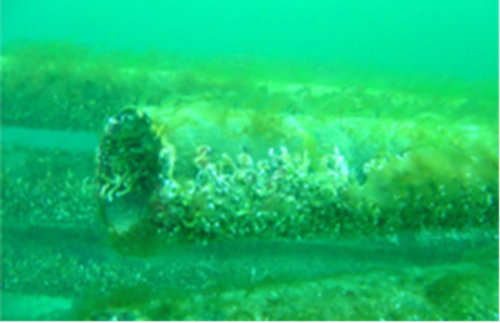
Figure 2 marine growth after 3 months
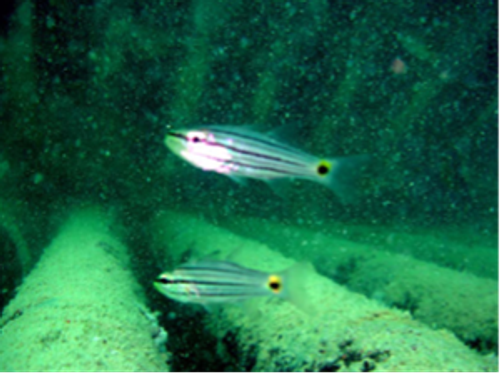
Figure 3 Flora and Fauna after 6 months
Conclusion
This new type of breakwater, which is IP protected and patented in several countries, has the following advantages:
- No large boulders or rocks have to be mined to form the breakwater.
- Concrete used is about 15% of conventional breakwaters made from concrete blocks.
- The environmental impact is positive as it creates a perfect substrate basis for marine life to grow. Substrate area is four times that of a conventional breakwater and it also provides protection areas for plankton and fish.
- The corals become a carbon sink as it will extract carbon dioxide from the atmosphere at an approximate rate of 0.15 tonnes per m2 / per year [1].
- With time the breakwater is covered in coral or kelp and becomes an actual solid garden, disappearing under the fauna and flora and creating a natural barrier against waves.
Tell us what you think about this article by joining the discussion on IMarEST Connect.
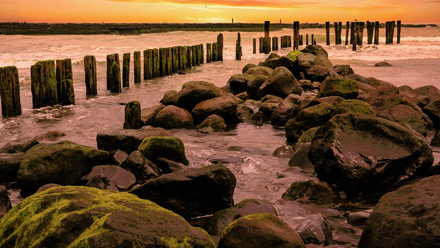
Image: breakwater with concrete blocks for protection. Credit: Shutterstock
[1] The significance of coral reefs as global carbon sinks, D.W.Kinsey D.Hopley