Case study: how seawater solved ballast water issue
Introducing the salinity-tank approach, and how ballast water regulation compliance was achieved
When the IMO Ballast Water Management (BWM) Convention came into force, ship operators faced one of the biggest retrofitting challenges in decades.
Fitting a compliant Ballast Water Treatment System (BWTS) across an entire fleet is rarely straightforward. Each vessel has its own unique arrangements and every flag state or classification society may interpret the rules slightly differently.
While working with Buena Vista Shipping (BVS), I was directly involved in managing BWTS plan approvals and saw first-hand how complex this process can be.
One case in particular highlighted both the challenges and the ingenuity required. The vessel’s aft peak tank (APT) was originally designed as a ballast tank. IRS Class required that all ballast tanks be covered under the BWTS installation. However, installing a separate filter and treatment loop for this small tank would have been impractical, costly and disruptive to operations.
The solution we implemented was the salinity-tank approach. By designating the APT as a permanent high-salinity tank kept filled with seawater, the tank itself became an environment unsuitable for invasive organisms to survive. This approach allowed us to demonstrate compliance with the IMO D-2 discharge standard without adding unnecessary equipment.
To support this, we prepared revised general arrangements, Ballast Water Management Plans and stability documentation ensuring class and flag acceptance.
This experience taught me three key lessons about making BWTS approvals work:
- Understand the technical flexibility in the rules
SOLAS (International Convention for the Safety of Life at Sea),MARPOL (International Convention for the Prevention of Pollution from Ships), and the BWM Convention all set minimum requirements, but there is often room for practical interpretation. In this case, the classification society accepted that a permanently saline tank met the intent of the regulation. - Documentation is as important as design
We had to carefully revise the vessel drawings, stability booklets and operational manuals. Approvals are rarely delayed because the idea is wrong, more often it is because the supporting documents don’t show the idea clearly enough. - Communication bridges the gap
This solution only moved forward because we engaged with class surveyors, the flag administration and the shipyard simultaneously. Each stakeholder had concerns, ranging from corrosion risk to stability impact, but open communication built unified consensus.
The salinity-tank approach is not a universal solution. It depends on the vessel’s trade, flag acceptance, and long-term operational practicality. However, it demonstrates that compliance is not always about adding more hardware; sometimes it is about smarter use of what is already on board.
Looking ahead, BWTS projects will continue to test the shipping industry. Ageing fleets, varying national enforcement and the complexity of system operation all add to the challenge. But with careful planning, sound technical reasoning and clear documentation, ship operators can find pathways that satisfy regulators without compromising efficiency.
For me, the project was a reminder that engineering at sea is rarely about textbook solutions. It is about balancing compliance, cost, and practicality while keeping safety at the centre. The salinity-tank approach was one example of how we can achieve that balance.
Tell us what you think about this article by joining the discussion on IMarEST Connect.
This article represents the views and thoughts of the author, and not necessary of IMarEST.
Ranadeb Ray is a Technical Assistant at Lloyd’s Register Marine & Offshore India LLP.
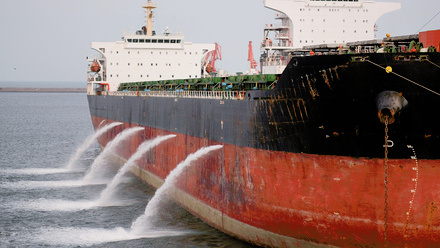
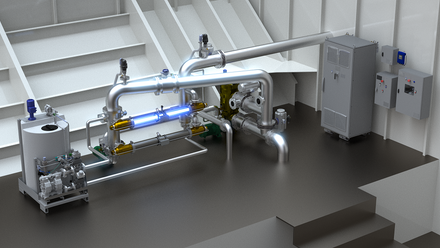
Image: close-up of ballast water exchange process. Credit: Shutterstock.