From land to sea to ‘a very special Institute’
For Professor Deborah Greaves OBE (FIMarEST), the strength of the IMarEST lies in its breadth. As the Institute’s 123rd President, she wants to build on that multidisciplinary foundation to bring more people together around the marine challenges of the future
Professor Deborah Greaves started as a civil engineer working on tunnels and bridges. While the work was fulfilling, “I always wanted to do something with the sea.”
After a PhD in computational fluid dynamics and fluid- and wave-structure interactions, Greaves moved to UCL to teach naval architecture, then to the University of Bath, where she began developing her research into wave energy.
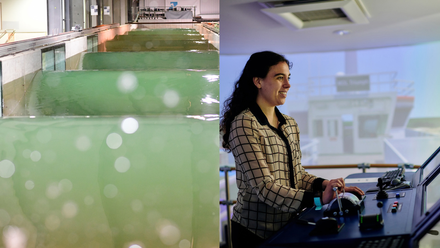
Now based at the University of Oxford as Statutory Professor of Civil Engineering, Greaves was previously at the University of Plymouth, where she created the Coastal, Ocean and Sediment Transport (COAST) laboratory, a physical modelling facility used to test how waves, currents and wind interact with offshore structures, marine energy devices and coastal environments. She also helped set up the Centre for Decarbonisation and Offshore Renewable Energy. She serves as director of the Sustainable PowER GENeration and supply (Supergen) Offshore Renewable Energy (ORE) Hub.
Professor Greaves says marine renewables will be an important part of the future energy mix. In the UK, offshore wind in shallow waters is well established. Efforts are now moving into deeper waters, bringing new engineering challenges around floating platforms and hybrid systems. In the future, tidal stream and wave energy, she says, could help diversify and strengthen the renewable supply.
Bringing disciplines together
In 2026, Greaves became the 123rd President of the IMarEST, something she describes as “a huge honour.”
“I think that the IMarEST is a very special Institute because it's multidisciplinary,” she says. “It's got a real opportunity to bring people together from different disciplines and to work together on some impactful solutions.”
That cross-disciplinary collaboration is vital for the future of the maritime sector, especially in the face of climate change. From adaptation to reducing emissions, finding solutions will require engineers, scientists, technologists, and others to work across disciplinary boundaries.
Underpinning that, Greaves says, is the need for an inclusive environment where people with different backgrounds, cultures and career paths, can all contribute.
“Those are my three themes for the Presidency – help strengthen the connections of early career researchers and students with IMarEST, working across disciplines towards tackling global climate challenges, and creating an inclusive environment that brings more people in.”
Widening participation
One of the challenges facing any professional institute is staying relevant to its members while reaching people who do not yet see a place for themselves within it.
Greaves points to ongoing work across the IMarEST to widen membership and listen more closely to the community, including developing the Institute's learning platform, strengthening the voice of its Branches, and creating more multidisciplinary forums through the Special Interest Groups, as well as enabling views from across the membership to be better reflected in decisions.
Greaves is also looking at the Institute’s equity, diversity & inclusivity strategy. She is the 123rd IMarEST president but only the second female president. The next president, Claudene Sharp-Patel, Global Technical Director at Lloyd's Register, will be the third.
For members, Greaves is looking at how the Institute can better support people throughout their careers. “Do we have people coming in at an early stage and then they drop off, and they don't continue? How do you support people if they take career breaks? Those are the sorts of things that I'm keen to think about.”
Greaves’ presidency runs until April 2027. Asked what she’d consider success for her year in office, “if we can look back and say that the Institute is more inclusive, more collaborative, then I think that would be a real success.”
Tell us what you think about this article by joining the discussion on IMarEST Connect.
Image: offshore wind turbines. Credit: Shutterstock