INEC 2026: why future-ready navies will depend on people and partnerships as much as technology
From autonomy and cyber security to the energy transition, INEC and iSCSS 2026 showed that future-ready navies will depend on collaboration as much as on new technology.
From 10 - 12 November, Edinburgh hosted IMarEST's International Naval Engineering Conference and Exhibition (INEC), incorporating the International Ship Control Systems Symposium (iSCSS). INEC’s three-day programme brought together professionals from navies and maritime companies to discuss 'Future Ready Navies’ while iSCSS 2026 explored topics on the theme of 'Future-Proofing Secure, Smart and Sustainable Ship Control'. A common theme emerged: collaboration and connectedness.
As Captain (Rtd) Neil McCallum (Royal Navy) announced, “the INEC theme for future-ready navies and navigating the seven Cs of competition, collaboration, capability, compliance, connectedness, crewing and climate was purposely broad reaching, yet interconnected and playing out before us.”
Common themes of collaboration and connectedness
During the introduction from the conference chairs, Captain Rinze Geertsma of the Netherlands Defence Academy stressed that navies needed to accelerate not only technological innovation but also organisational change.
Climate change is also high on the agenda. Capt. McCallum (Royal Navy) then distinguished between immediate geopolitical uncertainty and longer-term challenges such as climate change and energy security. These opening remarks set the stage for speeches that followed from Rear-Admirals who joined in person from the Royal Navy, the US Navy and Royal Australian Navy, along with Vice Admiral Sanjay Sadhu who joined online from the Indian Navy.
Adapting to climate and geopolitical change
Talks addressed challenges in the energy transition, from the specialist modelling of methanol and alternative fuels to Babcock’s lifecycle emissions assessment of a naval ship. Autonomy and robotics were also major features of the programme.
BAE Systems was the headline sponsor, and its Managing Director of Naval Ships, Sir Simon Lister KCB OBE FREng, spoke for the closing keynote on the first day. “Sovereign capability and international collaboration are not competing concepts,” he said. “They are mutually reinforcing.”
“Strong national capability creates a foundation for successful international partnerships, and so the global combat ship illustrates this clearly. The selection of the design by the UK, by Australia, Canada and Norway represents one of the most significant examples of naval collaboration between allied nations in recent decades.”
Sir Lister explained that “no single organisation will deliver the hybrid Navy. Success of the hybrid Navy will depend on collaboration between navies, platform providers, combat system developers, autonomy specialists, technology companies and regulators.”
The value of connectedness was clear, as Sir Lister showed how future naval engineering is becoming more of an integration challenge than an individual technology one. “Success will depend on the integration of people, platforms, systems and data.”
Diving into a diverse programme
By the second day, autonomous systems and ships were major discussion points. After morning keynotes from representatives at SSI, Fincantieri NexTech and Kongsberg, they came together for a Q&A discussion, in which questions around certification and the pace of technological change were raised.
After the two-minute silence for Armistice Day, the day’s parallel programmes began. This spanned crucial cyber security, where Morgan Colbeck from the Royal Navy spoke on The Combat Network as the Weapon, followed by Peter Macaulay, also from the Royal Navy, on how electronic warfare is the invisible enemy of maritime autonomy. Speakers addressed cyber warfare threats, where compromises can happen in the smallest of vulnerabilities. Sessions also spanned hot topics from digital twins to resilient ship design, through to decision support and autonomy.
The sense of collaboration and connectedness was experienced first-hand in the Industry Dinner, where industry and naval professionals from diverse fields across the world all ate together and saluted under one roof at the Sheraton Grand.
Final discussions on challenges for Future-Ready Navies
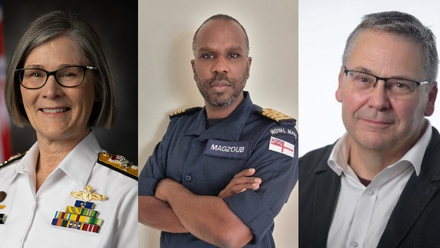
On the third day, Captain Mo Magzoub OBE FIMarEST, Head of Force Development, at the Royal Navy, discussed the Crewing and Capability aspect of the Hybrid Navy. He emphasised that the concept is not about autonomous systems replacing people: "We do not intend to reduce the crew or the number of deployed sailors, but what we absolutely intend to do is to give them more capability, to get the Royal Navy capability to the level we know it needs to be to meet the emerging and growing threat... We believe that the hybrid Navy offers us the ability to scale the Royal Navy at the pace that we know we need to."
That does not mean overhauling centuries of what has been learned. This is where the concept of minimum viable change was raised: "We have hundreds of years of knowledge and experience and what works,” said Captain Magzoub. “We don't want to throw the baby out of the bathwater. We want to change what must and keep what we can."
There are still many challenges to solve around supporting USVs, but minimum viable change provides a baseline. Engineering expertise remains crucial to solve these challenges ahead.
The intricacies of decision-making alongside autonomous systems were then addressed during the speech from Dr Bas Buchner of the Royal Netherlands Navy. The Q&A that followed included a question on the human element, in which Dr Bas Buchner answered that “we always say that there won't be uncrewed systems without a very good crew.”
That does not just concern training but decision-making, because, as Dr Buchner pointed out, “how you deal with all these systems is going to be very complex because there will be more information, there will be more systems you have responsibility for.”
The closing keynote from Sarah Kenny OBE, CEO at BMT, followed by the presentation of the Sir Donald Gosling Award and Patron Awards, finalised what had been a stimulating three days of discussions spanning ‘the seven Cs’.
Interested in this content? Then why not join the Naval Engineering SIG?
Tell us what you think about this article by joining the discussion on IMarEST Connect.
Image: Aerial drone view of armed navy patrol ship cruising deep blue sea
Credit: Shutterstock
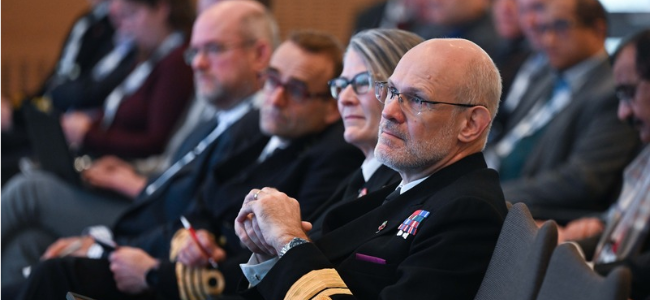
Inline image: Audience members at INEC
Credit: IMarEST