Lessons from the Aral Sea: more than a journey to a vanished sea
Funded by the David Henderson Inspiring Journeys Grant, Emaad Khan explored the Aral Sea and found it was more than an isolated disaster
“Water moving through time rather than simply a journey to a vanished sea” is how Emaad Khan, a cadet at the School of Marine Engineering and Technology at the Indian Maritime University in Kolkata, sums up his recent expedition to the Aral Sea.
Funded by IMarEST’s David Henderson Inspiring Journey grant, the expedition took place between 4 - 27 July and involved the following phases:
- Ancient maritime heritage – Silk Road (Samarkand)
- Bukhara – sustainable versus diverted water
- Following the Amu Darya (Khiva)
- Approach to the Lost Sea (Nukus, Aral Sea West Coast)
- Moynaq and the Vanished Sea
- Water abundance – modern systems (Charvak Reservoir).
Charvak – a large, Soviet-built reservoir/lake in the mountains above Tashkent – provided a “particularly interesting” perspective on the region’s relationship with water, says Khan.
“What struck me was the contrast between seeing water being deliberately accumulated and managed at Charvak, after having travelled northwest through a landscape where the consequences of taking too much water from a river system are visible on an almost unimaginable scale,” he says.
“I would therefore be cautious about describing Charvak simply as an ‘artificial maritime environment’. To me, it was more useful as an example of how engineering can create and manage a new aquatic environment to serve human needs.’
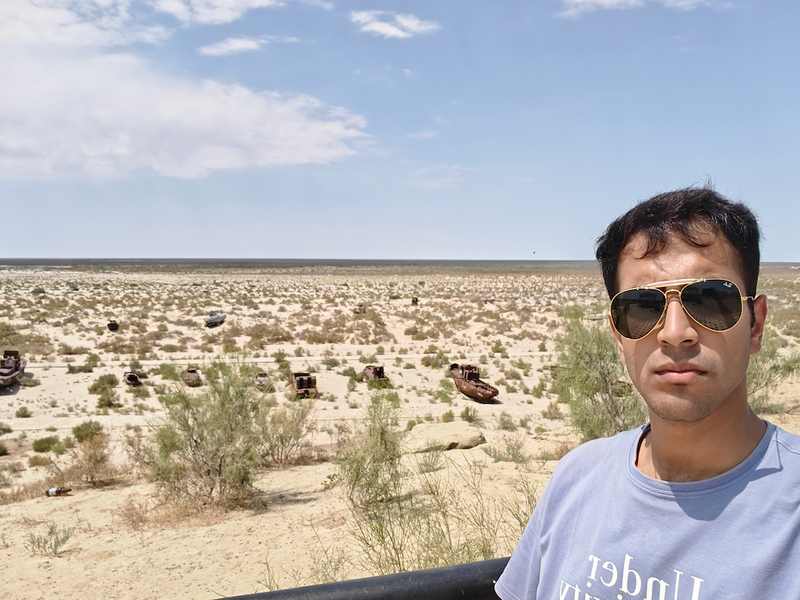
The Aral Sea demonstrates the other side of that equation – engineering intervention can also fundamentally alter an existing natural water system when withdrawals exceed its ecological limits.
The ancient, walled oasis city of Khiva provided the clearest physical demonstration of how human settlement in Central Asia has relied on water engineering for centuries.
“Inside and around the old city (Itchan Kala), I saw evidence of a dense network of canals – including the Polvon Ata, Lawzan and Abbas systems – that drew carefully-rationed water off the Amu Darya to sustain an oasis in genuine desert,” says Khan. “What struck me most was how difficult it was to separate the city from its water infrastructure – the oasis itself exists because generations of people continuously engineered, distributed and managed water. Walking it, you get a visceral sense that without that engineering, the land would simply be a continuation of the Kyzylkum desert around it.”
“This made Khiva an important contrast to the Aral Sea. Historically, these communities had developed systems and institutions for living within a water-scarce environment. The later expansion of large-scale irrigation operated on a fundamentally-different scale.”
Khan says Khiva became less a story of simply ‘adapting to changing water availability’ and more a demonstration that human settlements in arid environments can survive for centuries when water management, settlement patterns and ecological limits remain closely connected. “It’s a real resilience story,” he says, “though Khiva still draws from the same over-stretched river system that no longer reaches the Aral Sea at all.”
Mr Khan says the biggest surprise of the journey came “once I stopped looking at the Aral Sea as an isolated disaster and started following the water itself”.
“In Samarkand, I saw the historical relationship between the Zarafshan River and the ancient irrigation systems that sustained a major Silk Road city. In Bukhara, places such as Lyabi-Hauz and Bolo Hauz showed me that even public architecture was historically intertwined with water storage and distribution. In Khiva, the canal network made the oasis itself possible.
“Then, following the Amu Darya towards Karakalpakstan, that same relationship became much more stark. In the desert landscape, the green agricultural belts exist because water has been deliberately brought into an otherwise arid environment. Eventually, that same river leads to the landscape of the Aralkum.”
However, he says the “most powerful moment” was reaching the remaining western coastline of the Aral Sea – once the world’s fourth-largest inland lake.
“The Aral Sea disaster is widely regarded as one of the world’s worst human-caused environmental catastrophes. It began shrinking rapidly from the 1960s as the Amu Darya and Syr Darya were increasingly diverted for large-scale irrigation, particularly cotton cultivation under the Soviet system.”
Seeing the remaining water in person was very different from studying photographs or statistics, he says. “The scale of the former sea becomes difficult to comprehend precisely because so much of it is no longer there.”
This crisis is both a human story and an environmental one. Health, migration and livelihoods dominate conversation, with the shift in emphasis now from ‘saving the Aral Sea’ to helping people live with the consequences of its disappearance.
“In Tashkent and Nukus I met people working on wetland restoration, saxaul plantations, salt-tolerant agriculture, water-saving technologies, livelihood diversification, drinking water access and human security programmes,” he says. “At the International Innovation Center for the Aral Sea Region, for example, I saw practical experiments with salt-tolerant crops, aquaculture, drip irrigation and other approaches to making agriculture viable in highly-saline conditions.”
Khan says he encountered “very different” perspectives on the Aral Sea during his expedition.
“Institutional discussions tended to focus on restoration, adaptation, water efficiency and regional co-operation, while conversations with independent experts raised more fundamental questions about the economic structure of agriculture, the pricing of water and the incentives governing its use. That contrast was valuable because it showed me that there is no single explanation or single solution to the Aral Sea crisis.”
The Inspiring Journeys Grant was established in memory of David Henderson, who worked for the IMarEST from 2008 until his death in 2016 at the age of 31. David made an immeasurably positive impact on the lives of his colleagues and the Institute’s volunteers and members, with whom he worked very closely and tirelessly to support. This grant honours his desire for discovering the new as well as espousing the preservation of the oceans, something he worked very hard to protect through his role at the Institute.
Tell us what you think about this article by joining the discussion on IMarEST Connect.
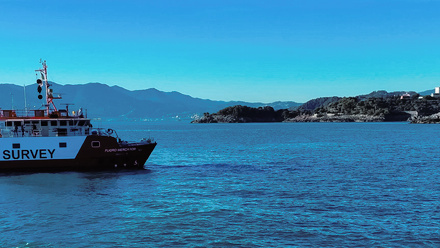
Main Image: The Aral Sea. Credit: Emaad Khan
Inline image: Emaad Khan visiting the Aral Sea. Credit: Emaad Khan