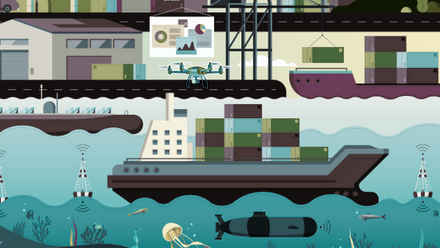
Smarter ports: data and AI are reshaping port operations
AI isn’t replacing humans, it’s helping them make port operations and maintenance more efficient. Ibrahim Abd-Elrahman Hassan shares some case studies from the frontline
Walk any busy terminal at shift change and you will hear the same questions. "When will she berth?" "Will the yard choke?" "Do we have trucks?" For decades, the answers lived in experience, radio calls, and spreadsheets. What is changing, quietly but decisively, is the way data is integrated and acted on. AI is not replacing the mariner's judgement. It is giving that judgement earlier, clearer signals, and that is where the real value sits.
A port is a system of systems. Ships, cranes, gates, trucks, weather, and human decisions all interact. AI becomes useful when it connects those pieces into a shared operational picture.
Rotterdam offers a strong example of what might be called AI as infrastructure. The port built a digital version of itself to support planning, safety, and asset management. Its Pronto system now predicts vessel arrival times with roughly 20 minutes precision up to seven days ahead. The result has been a 20% reduction in waiting times, which directly improves berth utilisation and gives engineers more predictable maintenance windows.
On the other side of the world, the Port of Los Angeles shows how visibility drives efficiency. Its Port Optimizer platform aggregates data across the port ecosystem and provides up to 40 days of advanced cargo visibility to more than 5,000 companies. When imports are visible this far in advance, the ripple effects reach the engine room. Auxiliary engine hours at berth shrink, and schedules become more stable.
Then there is the landside reality. Imports only move when trucks move. PSA Singapore's tools demonstrate what is possible at scale. Its OptETruck system has reduced empty truck trips by more than 50%, freeing capacity for productive moves. Another tool, OptEVoyage, has been applied across more than 3,000 port calls, saving an estimated 180,000 metric tonnes of bunker fuel and reducing carbon emissions by roughly 564,000 tonnes in a single year. When arrivals become just-in-time rather than race-and-wait, everyone benefits, including the engineer waiting for spare parts to arrive.
If ports are about flow, marine engineering is about availability. Keeping assets reliable under real operational constraints is the core challenge.
Classification societies are pushing AI into areas where it is most defensible. ABS, working with Google Cloud and SoftServe, has piloted AI image recognition to detect corrosion and coating breakdown on ships and offshore structures. The goal is to reduce the need for physical attendance while improving inspection consistency and speed.
The strongest real world signal comes from a 2025 agreement between CMA CGM and Wärtsilä. The deal includes AI-powered predictive maintenance support for 14 LNG fuelled container ships. Wärtsilä's Expert Insight service combines real time vessel data, AI based diagnostics, and human expert review. It is an important reminder that in critical machinery decisions, keeping a human in the loop remains the safest route.
Lloyd's Register, together with NYK and MTI, has highlighted the industry shift toward data driven condition based maintenance. Their work points to benefits including increased equipment availability, reduced downtime, and lower total maintenance costs. They are also honest about the obstacles, which include checklist precision, schedule deviations, and the need for clearer hazard criteria.
Tell us what you think about this article by joining the discussion on IMarEST Connect.
Image: Port of Los Angeles. Credit: Shutterstock