Fatality on board Ever Felicity in Japan connected to palm kernel shells
In 2024, two stevedores lost consciousness and collapsed inside a cargo hold, with one subsequently losing their life. The incident led BIMCO to warn of the hazards associated with transporting palm kernel shells.
Palm kernel shells (PKS) are fibrous husks and a byproduct of palm oil production, but when enough PKS is packed together, it possesses unique risks. According to shipping association BIMCO, bulk transportation can lead to, “self-heating, oxygen depletion and the production of carbon monoxide and methane”.
This combination can be both a fire and an asphyxiation hazard, the latter thought to be a key factor after two stevedores collapsed when entering the hold of bulk carrier Ever Felicity in 2024.
What happened on the day
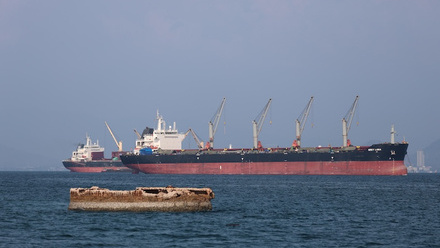
On 20 May 2024, at around 07:05, Ever Felicity was berthed at the North Wharf of Hibarino in Ishinomaki Port, Japan. The vessel had been engaged in loading PKS, increasingly recognised as a sustainable source of biomass energy and alternative to fossil fuels, stored in open piles on the quay, destined for cargo holds No.1 and No.2.
Loading had proceeded from 15 to 18 May, with a pause on 17 May due to bad weather, and there was no work planned for 19 May. Subsequently, the hatch covers of holds No.1 and No.2 were closed overnight. On the morning of 20 May, hatch covers were reopened in anticipation of resuming the loading operation.
At the morning pre-operation safety meeting of nine stevedores, a discussion of hazard prediction and general operational procedures made no mention of taking atmospheric measurements inside the cargo holds.
The PKS load in No.1 hold was uneven – aft, it had been loaded higher, close to 10.3m above the tank top (2.6m below the upper deck); in the fore half of the hold, around 7.7m above the level of the tank top.
The operation would involve the lowering of a backhoe excavator via crane into the cargo hold, a common operation for the purposes of evening out the loads, pushing cargo underneath hatch coamings, or assisting in unloading. Stevedores A and B would detach the crane lifting fixture from the backhoe once it had been lowered, whereupon Stevedore B would operate the vehicle.
The two stevedores descended into No.1 hold using a vertical ladder at the hatch coaming, at around 7:30am. No atmospheric testing had taken place. The crane operator took his seat, ready to lower the excavator into the hold.
Inside the hold, it was not long before both stevedores succumbed, lost consciousness, and collapsed. The crane operator, noticing he was unable to raise the two on his radio, rotated the crane to discover them lying motionless atop the PKS pile.
An emergency call was made, while rescue personnel with breathing apparatus found oxygen concentration inside to be lower than normal atmospheric levels.
Both men were taken to hospital, where one sadly passed away. The other crew member, thankfully, was discharged from hospital later the same day.
It was noted that rescue efforts were initiated promptly after the incident, as firefighters, the coast guard and emergency services arrived within minutes. When air measurements were taken, they confirmed that oxygen in one part of the hold had dropped to a dangerously low level of 17.6% (standard oxygen concentration in ambient air is 21%).
Recommendations following the incident
The Japan Transport Safety Board (JTSB) investigation concluded that the most likely cause of the accident was oxygen deficiency inside the cargo hold, resulting from entry into the hold without prior atmospheric measurement. The victims inhaled air with oxygen concentration significantly below standard atmospheric levels, and elevated carbon dioxide levels, leading to loss of consciousness and collapse.
The report found there was no testing of the atmosphere in the hold before entry, which represented a basic confined space entry protocol not followed. There was also a lack of oversight from the management, with no adequate risk assessment or safe system of work or procedures “in accordance with the relevant laws and regulations”.
Although the JTSB investigation does not assign legal blame or liability, the conclusions act as a firm admonition: cargo-hold entry must not proceed without prior measurement of atmospheric conditions, regardless of perceived low-risk – in this case due to the vessel berthing in a “light condition [with] no perceived hazard in the hull” and that, “the loading condition could be conducted simply by reversing the unloading procedure… based on prior experience.”
Recommendations included following mandatory atmospheric testing protocols before entry into cargo holds with organic materials, enhanced training and further development of guidelines for handling high-risk cargoes.
Image: close up of palm-kernel shells. Image: Shutterstock.