Agentic AI: the next leap in maritime operations
From berth planning and predictive maintenance to fuel optimisation and regulatory compliance, agentic AI is changing how maritime operations are managed. The challenge for the industry is to turn greater automation into lasting competitive advantage.
Maritime transport underpins the functioning of the global economy, yet the operational infrastructure supporting it has been slow to modernise. Port terminals and shipping companies have historically managed vessel movements, cargo handling, and regulatory compliance through combinations of experience-based judgement and legacy software that was never designed for the complexity or speed of contemporary trade flows. The result is a sector characterised by persistent inefficiencies: vessels queuing at anchorage, berths allocated through negotiations conducted over telephone and email, and maintenance decisions taken on fixed schedules rather than in response to what machinery is telling its operators. Agentic AI software systems that do not merely display information but perceive, reason, and act, represents a substantive departure from this model, and its adoption across maritime and port operations is accelerating.
Removing bottlenecks
What distinguishes the present moment from earlier waves of maritime digitalisation is the shift from decision-support tools to decision-executing systems. Earlier generations of software presented operators with better data; agentic systems act on that data autonomously, within defined operational boundaries, without requiring a human to translate insight into instruction. This shift is consequential because the bottleneck in most port and fleet operations is not the availability of information but the speed and consistency with which that information is converted into coordinated action across multiple interdependent systems.
At the port level, the most mature applications are in berth planning, yard management, and equipment coordination. Intelligent scheduling agents can hold a simultaneous model of vessel arrival sequences, berth occupancy, crane availability, and yard capacity, continuously rebalancing allocations as conditions change, a task that exceeds the practical capacity of any human planning team working in real time. The commercial case for this capability is straightforward: a reduction in vessel idle time translates directly into lower port dues, improved slot reliability for shipping lines, and higher throughput per unit of infrastructure.
Fleet operations have seen parallel development. Condition monitoring agents that continuously analyse machinery sensor data are replacing fixed-interval maintenance regimes with intervention schedules calibrated to actual component state. The economic advantage is twofold: serviceable components are not replaced prematurely, and failures that would otherwise occur at sea with all the associated costs of emergency repair, schedule disruption, and potential safety consequences, are anticipated and addressed in port. Fuel management has followed a similar trajectory, with agents optimising trim, speed profiles, and power plant configuration in response to real-time conditions, producing measurable improvements in the carbon intensity metrics that now carry direct regulatory and financial consequences under international emissions frameworks.
Compliance management, historically one of the most administratively burdensome aspects of ship operation, is also being transformed. The documentation requirements associated with international voyages, emissions reporting, customs declarations, cargo manifests, port state control submissions can now be handled by agents that extract the relevant data from operational systems, populate the required formats, and submit through the appropriate channels with minimal human involvement. The practical effect is a substantial reduction in both the administrative overhead carried by vessel and office staff and the error rates that generate costly delays and resubmissions.
Coordination at speed
The next significant development in maritime agentic AI is the emergence of coordinated multi-agent systems operating across organisational boundaries. A vessel agent that can negotiate directly with a port agent over berthing windows, simultaneously coordinate with a logistics agent over cargo readiness, and autonomously initiate communication with a classification society over an upcoming survey represents a qualitatively different kind of operational infrastructure, one in which the coordination costs that currently consume substantial time and resource across the supply chain are absorbed by software operating at machine speed.
This trajectory has implications for the human role that deserve careful consideration. The work being displaced is predominantly the high-volume, rule-governed transactional work that occupies a large proportion of operational staff time but draws minimally on the capabilities that humans bring distinctively: contextual judgement, relationship management, creative problem-solving under genuine uncertainty, and the ability to act responsibly in situations that no procedure anticipated. As agentic systems absorb the transactional layer, the human contribution concentrates progressively in these higher-order functions. This is not a straightforward substitution but a restructuring of what maritime professionals are asked to do, and it will require corresponding changes in how they are trained and how organisations are designed.
First-mover advantage compounds
For port operators and shipping companies, the strategic dimension of this transition is increasingly difficult to defer. Operational performance differentials between organisations that have integrated agentic systems and those that have not are becoming visible in turnaround statistics, fuel consumption records, and maintenance cost data. Shipping lines, allocating vessel calls across competing terminals, are sensitive to these differentials. The compounding nature of early-mover advantage in network-dependent industries means that the decision about when to invest is not strategically neutral, delay has a cost that is not always visible until it has already been incurred.
The longer-term horizon points toward operational autonomy of a more comprehensive kind: voyage planning, exception management, supplier coordination, and regulatory reporting handled end-to-end by agent systems, with human oversight structured around approval of consequential decisions rather than execution of routine ones.
The maritime industry of the next decade will not be one from which people have been removed. It will be one in which the work people do has been fundamentally changed by the arrival of systems capable of handling, reliably and at scale, everything that does not require them.
Tell us what you think about this article by joining the discussion on IMarEST Connect.
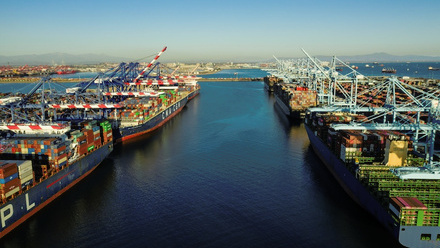
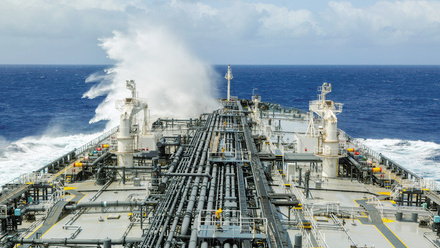
Main image: Aerial view of a port at sunset
Credit: Shutterstock