AI transforming energy-efficient hull design
Models for calculating hull wave resistance are often designed for traditional merchant vessels, which may not always be accurate for more specialised vessels, such as PSVs. A new AI tool developed in Norway aims to fix that
An AI-based tool created by SINTEF Ocean, located in Trondheim, Norway, with key input from SIRIUS Design & Integration, is expected to help improve the speed and accuracy of initial calculations on the wave efficiency of new hull designs.
According to SINTEF Ocean senior research scientist Øyvind Rabliås, the tool, developed as part of the Norwegian Research Council-funded KSP ZeroLog project, can undertake speedy analysis of new concepts against a trove of established towing tank data.
Although difficult to quantify exactly how much faster the new method, he estimates “around one hour per design, which is quite significant in the early phase of exploring ship designs”.
“In principle, AI methods can be compared to traditionally-empirical methods – however, the advantage is that with AI it is much easier to train the method on new data,” said Rabliås. “Hence, when new data is included in the database, the method can be updated, which will improve the accuracy. This means that the industry now has an accurate method that can be used at an early stage in the design process.”
He compared this to “traditional” non-AI based methodology, whereby new ship concepts start from the basis of existing designs.
“Based on ship designers’ experience and previous projects, small adjustments and improvements are made to existing ship designs,” said Rabliås. “In the early phase of a design, they rely on their experience and empirical formulas, such as the Hollenbach method and the Holtrop and Mennen’s method. In the next phase, more accurate methods are used to predict the performance [and] today CFD (Computational Fluid Dynamics) is state of the art for such calculations. Sometimes model tests are also conducted to verify the performance of new ship designs.”
The AI-based tool will make the early stage more efficient, according to Sirius Design & Integration chief technology officer Henning Borgen. His Ålesund-headquartered firm – which operates extensively in developing next-generation PSVs – will use the tool in its future projects.
“This type of tool is closely tied to our core business and enables us to perform faster and more accurate calculations,” he said. “For us, the development of such useful tools for industrial use is the main motivation for participating in research projects.”
Development of the tool – which has been released in SINTEF’s ShipX software workbench for ship designers – was initially focused on Norwegian oil and gas platform supply vessels (PSVs) of typically 60-100 metres’ length and 15-22 metres’ breadth.
By reducing the waves created by the hulls of these next-generation PSVs as they transport food, equipment and materials to the platforms on the Norwegian continental shelf, fuel costs, operating costs and emissions can be cut.
Øyvind Rabliås observed that while a number of models already exist for calculating hull wave resistance based on measurements and data, they are largely designed for traditional merchant vessels. But, given the Norwegian maritime industry works extensively with specialised vessels – such as PSVs – traditional methods perform far less accurately, he said.
“That is why we believe the newly-developed method will be a valuable contribution for achieving more accurate estimates of calm water resistance for offshore vessels in the early stages of a project,” he said.
He emphasised, however, that the methodology can be expanded to develop new designs for a wide range of ship types.
“SINTEF has a database with model test results of thousands of ships, within all kinds of segments, and the plan is to extend the method to other ship segments,” he said, adding that the timeline and decisions about which segments will be prioritised have yet to be finalised.
Tell us what you think about this article by joining the discussion on IMarEST Connect.
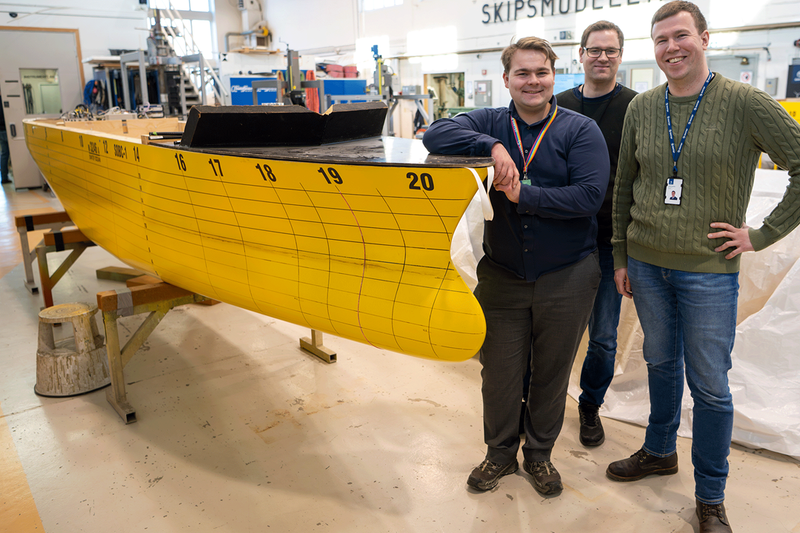
Image main: A model in the towing tank. Credit: SINTEF
Image inline: SINTEF Ocean’s Thor Albrektsen, Øyvind Rabliås and Endre Sandvik in front of one of many physical models that have been tested in the firm’s towing tank