Artificial reefs: inside the unusual structures providing shelter for marine life
Beneath the waves off Florida, a retired aircraft carrier lies upright on the seabed. In Mexico, hundreds of silent human figures stand in formation as coral slowly claims their faces. In the North Sea, a ‘boulder barrier’ sits atop the Dogger Bank sandbank
These artificial reefs – defined as any hard structure intentionally placed on the seabed – are mostly designed to create a habitat for marine life. They can also serve other purposes, such as preventing coastal erosion.
Artificial reefs are far from a new idea. In the Mediterranean Sea, tuna fishers were creating them inadvertently 3,000 years ago – heavy boulders used to anchor seasonal nets were left behind on the seabed when the nets were cut free, and were colonised by marine organisms over time. They then became productive fishing grounds that could be used outside of tuna season.
From ships to bricks
Today, the installations come in a variety of shapes, sizes and materials. Some are repurposed structures, others purpose-built.
Nowhere has embraced them like Florida, which aims to create habitats for fish and corals, and to boost dive tourism.
In 2006, the USS Oriskany, an Essex-class aircraft carrier built just after World War II, was sunk following remediation work to remove toxic and hazardous materials. The vessel has since been nicknamed the ‘Great Carrier Reef’ – a nod to the natural Great Barrier Reef in Australia – and is one of the most popular dive sites in the US.
Oriskany’s crown as the largest artificial reef created from a vessel is expected to pass to the SS United States, an ocean liner built in the early 1950s that once carried passengers including Harry Truman, Marilyn Monroe and Salvador Dalí. Following similar remediation, the liner is set to be scuttled in Florida waters this year.
Elsewhere, the 30-metre steel prop ship that portrayed the Black Pearl in the Pirates of the Caribbean franchise was recently sunk near Panama City Beach. Unlike older naval vessels, the ship lacked engines and other components requiring extensive cleaning, simplifying preparation before deployment.
Artificial reefs formed by vessels are invariably attractive to divers. In other places, a more creative approach has been taken.
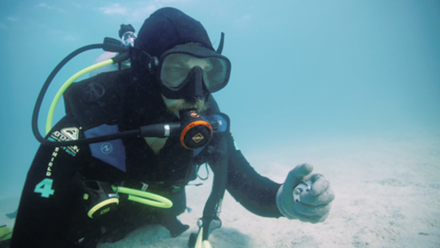
Off the coast of Cancún, British-born artist Jason deCaires Taylor submerged around 450 life-size cement cast figures as part of The Silent Evolution, an installation at the underwater museum MUSA (Museo Subacuático de Arte). The project was conceived not just as art, but as environmental management. By offering an alternative attraction, the museum hoped to divert visitors away from nearby natural reefs that were suffering damage from heavy tourism. Over time, corals and other marine organisms have settled on the sculptures, gradually transforming the artwork into a living reef.
Function over form
Not all artificial reefs are designed to be attractive. For some, function is more important than form.
In the Kep province of Cambodia, as with the ‘boulder barrier’ in the North Sea, anti-trawling reefs have been deployed to entangle bottom-trawling nets that are operating illegally in the area and damaging sensitive marine habitats. Constructed from concrete and rebar, these not-so-beautiful structures have brought some positive changes. Seagrass close to the reefs are showing signs of recovery, and the structures themselves are attracting marine life. Some were seeded with local oyster spat, with the aim of filtering the water and supporting local livelihoods.
Off the Sussex coast, ‘reef cubes’ made from recycled waste aggregate were placed around the base of offshore wind turbines at the Rampion Offshore Wind Farm in 2025. Created with rough surfaces and holes through their centres, the cubes are designed to protect the turbines from erosion and provide a habitat for marine life. A five-year study will assess how effective they are.
Cautionary tales
Unfortunately, the history of artificial reefs is not without disasters. In the 1980s, approximately two million discarded tyres were clipped together with steel and nylon fasteners and dumped offshore near Fort Lauderdale in Florida. The goal was to create a habitat that would offer fishing opportunities and address a waste disposal problem – but instead, the fasteners deteriorated, the tyres broke loose and storms scattered them across a much wider area than intended. Natural coral reefs were smothered and damaged. Clean-up operations began in 2001 and continue to this day.
Material choice has posed other problems. Refrigerators, engines and other debris have in some cases been deployed without adequate removal of toxic components. Even carefully planned projects are not without concerns – a year after the USS Oriskany was sunk, elevated PCB levels were recorded in nearby reef fish, though these levels later declined.
Location and design are equally important. Artificial reefs must be placed with careful consideration of local currents, sediment transport and existing habitats. Introducing hard structures onto sandy or muddy sea floors inevitably changes the ecosystem. Species that depend on solid surfaces may flourish, while soft-bottom communities could be displaced.
Scientists also continue to debate whether artificial reefs genuinely increase overall fish production. Fish are naturally attracted to structures in the ocean. While some artificial reefs may boost fish numbers, others may simply be drawing fish in from surrounding areas.
A tool, not a solution
Carefully designed artificial reefs may prove to be valuable tools for supporting marine life and the communities that depend on it. For now, the science is still relatively young, and will require long-term studies to understand what works, what doesn’t and why.
Artificial reefs are not natural, and we should not expect them to behave as such. They can complement conservation efforts and buy time for damaged ecosystems to recover. But they are interventions, not replacements, and their growing use should not distract from the urgent need to protect the reefs that nature has already provided.
Tell us what you think about this article by joining the discussion on IMarEST Connect.
Main image: Human statues form an artificial reef at the Museo Subacuático de Arte in Mexico. Credit: Juan_Chanclas via Flickr, ‘Museo subacuatico de Cancun (MUSA)’, CC2.0.
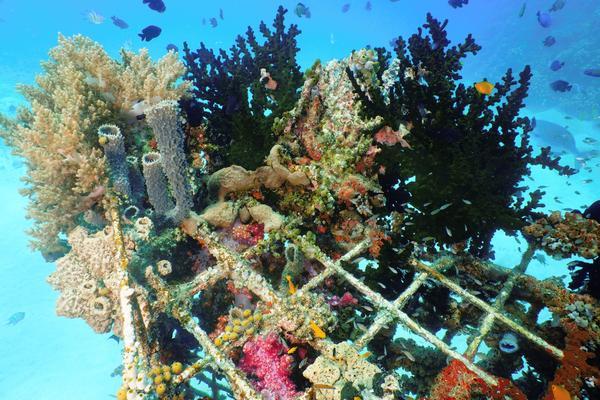
Inline image: An artificial reef in Bali, Indonesia. Credit: Shutterstock.