Can nuclear fuel the maritime transition?
With nuclear propulsion increasingly discussed as one of shipping's few credible routes to zero-emission deep-sea transport, we report from the recent Nuclear Propulsion in Shipping conference in Norway
Financing nuclear powered ships should not pose any problems for the shipping industry, which is used to innovative financing according to Citigroup.
Speaking at the recent Nuclear Propulsion in Shipping conference hosted by the National Technical University (NTNU) in Ålesund, Norway, Alfred Butros, director global shipping at Citigroup, explained that ever since the US launched the Liberty ships in the 1940s, shipping has found ways to finance innovation in the industry.
“In my mind, ultimately, financing for nuclear should be just another iteration of what is a well-established maritime finance framework that's been there for 50 or 60 years and continues to be supporting the industry on a wider basis,” Butros told the conference.
Butros was, however, referring to a more established technology, whereas most of the delegates at NTNU accepted that the initial versions of any type of small modular reactor (SMR) would need strong government support in the proving stage of the technology.
Nevertheless, the optimism in Ålesund was high. Per Peterson, until February the chief nuclear officer and founder of Kairos Power before joining Tesser Atomics, is developing a SMR for a Knutsen LNG carrier, which it, optimistically, says will be launched by 2031.
Tesser Atomics is partnering Vard and Knutsen to retrofit Kairos Power's Fluoride salt-cooled High-temperature Reactor (KP-FHR) to the 77,200dwt LNG carrier Cadiz Knutsen. According to Peterson, LNG carriers often use steam turbines to power direct propulsion systems and as such the Cadiz Knutsen already has two MHI, 65,000kg/h boilers, simplifying the transition from conventional to nuclear power.
Building the first nuclear shipping corridor
KP-FHR is, said Peterson, a gateway technology that could open a significant initial nuclear trade route between Texas and Europe that would be a proving ground for SMR technology. If successful, it could lead to up to 50 nuclear powered tankers transporting LNG along this nuclear corridor.
That in turn would act as a driver for further nuclear corridors to open, which will, eventually achieve the economies of scale that Peterson and other speakers believe will ultimately reduce SMR production costs by up to 80%.
Some studies have however suggested that the nuclear industry vastly over-estimates the economies of scale achievable. Dr Edwin Lyman, the director of nuclear power safety at the Union of Concerned Scientists in Washington, DC, cites a 2018 study from the University of Cambridge in the UK, which he says remains relevant. It concluded the nuclear industry could achieve just 30% cost reductions through mass production.
Safety by design: the role of TRISO fuel
Cost control will be a critical factor in the development of nuclear, and safety will also impact costs.
As such a critical element of the project is the Tri-structural isotropic fuel, known as TRISO, that has an in-built passive cooling system of molten fluoride salt, allowing the reactor to operate at low pressure.
TRISO fuel ‘pebbles’ are uranium fuel, enriched to 19.75%, encased in ceramic spheres on the outside and four layers of protective pyrolytic carbon inside, producing a ‘pebble’ shaped fuel.
The KP-FHR will have a pebble bed that will provide the heat to create the steam driving the turbines that will ultimately generate the electric power necessary to operate the ship.
TRISO fuel particles are designed not to crack from thermal or mechanical stresses at temperatures of up to 1,600oC that will contain radioactive material even during severe accidents.
Who regulates a nuclear-powered ship?
This will be key when classification societies develop the standards that nuclear powered ships will need to achieve to remain safe.
Class, said DNV’s principal consultant on maritime environmental technology, Eirik Øvrum, consider the seven main functions of a ship, such as structure strength, watertight integrity, steering, fire safety, stability, power generation and propulsion, when assessing safety.
It is the last two, power generation and propulsion, that class will be most interested in when developing the rules for nuclear ships, as will the nuclear regulator and flag states.
Øvrum argues that class and flag states are very used to working together, with class focusing on the main functions and flag states on other issues, such as lifesaving.
“It could be that one of the main functions, quite a large portion of the main function, power generation and propulsion, is not going to be done by class. It will have to be done by the nuclear regulator,” said Øvrum.
Moreover, Øvrum believes that the collaboration between class, flag state and nuclear regulator will be critical, particularly in the initial development of the propulsion systems.
Later there will be a requirement for owners, naval architects and engineers to align with the yards and class, and to work with the flag state and the nuclear regulator to bring this technology to maturity.
To lubricate that process, Janne Wallenius, CTO at Swedish company Blykalla, who was also in Ålesund, referenced the Vard project known as NuProShip II. This stands for ‘Nuclear Propulsion in merchant Shipping’ and is a Vard design that demonstrates the technical feasibility of nuclear-powered vessels.
Wallenius explained the significance of NuProShip in the development of nuclear-powered shipping: “The NuProShip project has really brought together all of the necessary areas of expertise and competence.”
Meanwhile Vard, described the project as “leveraging advanced reactor concepts” that will offer a pathway to zero emission shipping and extended operations.
“The project also explores innovative energy storage solutions, such as super-critical CO₂ turbines and thermal battery systems, which could provide power balancing alternatives to conventional electrical batteries,” said Vard.
Learning from land-based nuclear
Critically, Wallenius pointed out that the key to the Vard design was to maintain close designs to land-based technology.
“What we've recognised [from the NuProShip project] is that from the perspective of the nuclear regulator, what we'd like to do is to find ways to have the deltas between a land-based reactor and the marine reactor be as small as possible when we present the license application to them,” explained Wallenius.
Technologically the design is progressing - the development of a steel and aluminium material has allowed Blykalla to develop uranium nitride fuel that would power low-cost electricity production.
The next step for Blykalla and for other nuclear reactor designs is to prove the concept designs work. And that brings us back to the key question of finance that the industry must unlock to test the theories.
IMarEST: a role to play
“There remains an enormous body of work to undertake before society can make an informed decision on the role of nuclear propulsion in commercial shipping,” said Alasdair Wishart, FIMarEST, Technical & Policy Director at IMarEST, highlighting the need for a multi-disciplinary approach. “It requires naval architects, marine engineers, nuclear specialists, surveyors, environmental scientists, regulators, insurers, operators, academics and policymakers working together. That is why I believe IMarEST is uniquely positioned to lead this conversation and bring together experts from across the marine ecosystem to challenge assumptions, interrogate evidence and develop practical solutions.”
IMarEST is looking to convene those experts through the formation of a dedicated Special Interest Group focused on nuclear energy in the maritime sector.
“Through the collective expertise of our membership, we can strengthen the trusted technical voice of IMarEST at the IMO and help ensure that any future conventions, codes and regulatory frameworks relating to maritime nuclear propulsion are safe, proportionate and fit for societal needs,” said Wishart.
If you’d like to be part of this conversation, please contact [email protected].
Tell us what you think about this article by joining the discussion on IMarEST Connect.
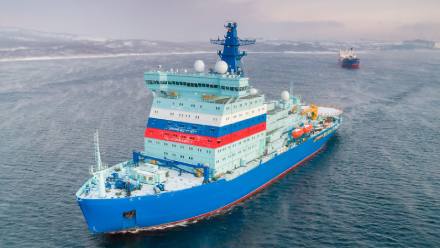
Image: Nuclear-powered cargo container ship & icebreaker, Northern Sea Route, Russia. Credit: Shutterstock