Waterjets: the propeller alternative embraced by the Indian Navy
All propulsion systems have their trade-offs, and sometimes waterjets have the edge over propellers
In September 2025 the Indian Ministry of Defence unveiled its 15-year modernisation plan for its Navy. Alongside large platforms like destroyers, it includes Next Generation Missile Vessels (NGMVs) – fast-attack corvettes built for speed, strike capability and the shallow coastal waters larger ships cannot reach.
These vessels won't be powered by conventional propellers. Instead, each vessel will be driven by Kongsberg Maritime Kamewa waterjets.
The case for waterjets
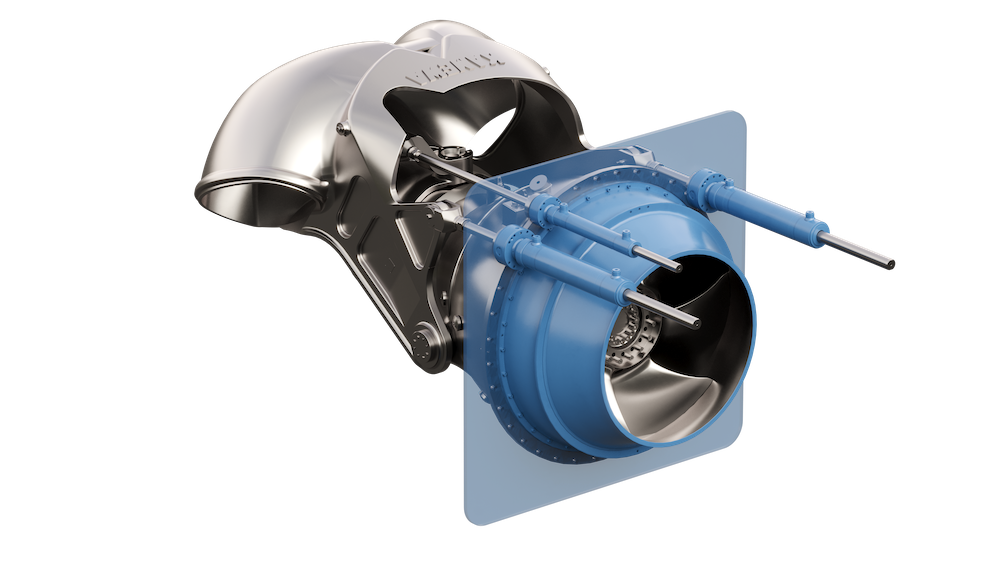
A waterjet works by drawing water into the unit, accelerating it through an impeller, and ejecting it at high velocity to generate thrust. For vessels like the NGMVs, they offer three main advantages, namely speed, manoeuvrability, and shallow-water capability.
Propellers have a physical speed limit. Push them hard enough and the blades cavitate, erode, and may need to be impractically large for the power required.
"If you deliver 10 megawatts of propulsive power, you would need a four, five metre propeller to be efficient," says Göran Grunditz, Director of Hydrodynamics at Kongsberg Maritime. But "you can do that with a one metre waterjet."
Then there is manoeuvring. Whereas a propeller-driven vessel relies on rudders and reversing thrust, a waterjet redirects its thrust using a mechanical bucket. "With a waterjet you can remain on very high-power output and basically hover the vessel," says Grunditz. "Full power [is] instantaneously available."
Waterjets also allow vessels to operate in shallower waters than a propeller equivalent. With waterjet intakes flush in the hull plating, the NGMV achieves a draught of less than 3.4 metres. Propellers would add exposed equipment below the hull, reducing that shallow-water advantage.
Engines, fuel, and a decarbonised future
Engine choice is closely linked to speed and power requirements. The engines behind the NGMVs will be gas turbines. “Gas turbines are known for massive amounts of power in a small space, so the combination [of gas turbines and waterjets] fits fairly well,” says Fredrik Appel, Director of Products, Waterjet Systems at Kongsberg Maritime.
Crucially, “gas turbines have a very low weight per kilowatt power delivered,” says Grunditz. For semi-planing and planing vessels – boats that ride on top of the water – reducing weight helps improve both performance and fuel consumption at speed.
With increasing focus across the maritime world on decarbonisation, one question for any high-performance vessel is how that performance profile can be sustained on cleaner fuels.
Waterjets demand high torque, particularly when the vessel is driving up onto the plane. That demand limits which power sources can drive them. "We are more or less forced into the high-speed engine segment," says Appel. "The waterjet needs enough torque during acceleration, otherwise we will never reach the planing phase."
The challenge is that not every alternative-fuel system can provide the torque needed to get a waterjet-driven vessel onto the plane. Electric motors, however, are one promising option.
"Combining electric motors with a range extender running on biodiesel, LNG or methanol…that's the combination that will work out quite well," says Appel. As battery technology matures, hybrid-electric pathway for waterjet-driven becomes viable.
Vessel design for the right situation
All propulsion systems have their trade-offs. "There are pros and cons with both [propeller and waterjet] systems," says Appel. "You need to apply them wisely depending on what type of vessel you are building."
Waterjets offer speed, but at the expense of range. Simply put, "if you want to go fast, you will burn a lot more fuel," says Appel.
For larger warships like frigates and destroyers, range matters more than sprint capability. Here, propellers are, and will likely stay, the preferred choice. Another trade-off comes with low-speed operations. At lower speeds, the efficiency advantage shifts back to the propeller.
The NGMVs, however, are neither designed for range nor to operate primarily at low speeds. They are fast, agile, and operating close to shore in waters that larger ships cannot reach. For this use case, waterjets fit the mission.
Tell us what you think about this article by joining the discussion on IMarEST Connect.
Main Image: Next Generation Missile Vessel for Indian Navy. Credit: Kongsberg Maritime
Inline image: A Kongsberg Maritime Kamewa waterjet. Credit: Kongsberg Maritime