From first movers to mass adoption: making the IMO Net-Zero goal achievable
The design options of the IMO’s proposed Net-Zero Framework and consequential Net-Zero Fund could be critical to turning early investment in zero- and near-zero-emission fuels into a self-sustaining market. The choice of reward mechanism will need to balance value for money with the certainty needed to unlock investment and encourage early adoption.
For the last few years, the International Maritime Organization (IMO) has been working towards adoption of its Net-Zero Framework, a set of regulations aimed at reducing greenhouse gas emissions from ships over 5,000 gross tonnage.
Details of the framework are still under discussion, but options include the creation of a Net-Zero Fund. Ships that exceed emissions thresholds would need to rebalance their emissions through emission credit trading (Surplus Units), such as between ships. If that is not possible, they would pay into the Net-Zero Fund (Remedial Units).
“The revenues should be used for rewarding users of zero- and near-zero-emission fuels (ZNZs), and for just and equitable transition purposes that support the needs of low-income countries,” says Dr Tristan Smith (FIMarEST), Professor of Energy and Transport at University College London and part of the IMarEST delegation to the IMO.
The question is how that money could be distributed equitably so that net-zero goals are reached in line with the agreed 2023 IMO GHG strategy on reduction of GHG emissions from ships.
Finding the right reward price
One of the distribution options being explored is reverse auctions.
“A reverse auction is a standard tool that is used quite frequently in policy to get a certain amount of subsidy or support into a market in the most competitive way possible,” Smith says.
In brief, “the IMO would set up an auction window, and the market would say what price they would need as a subsidy in order to operate on ZNZs, and the IMO would allocate the money to those who had the lowest price.” Because the auction allocates a pre-determined amount of the fund’s revenues, it can guarantee a reward rate for a period of time into the future.
The alternative solution would be a fixed price option. “Instead of going to the market and saying, what price do you need, the IMO would say ‘we think if we set the subsidy at this rate, the market will be able to use it in order to create the use of ZNZs that we’re trying to stimulate,” Smith explains.
However, this mechanism then needs to be able to manage the situation where there is more demand for these fixed rewards than there are funds available – with current options under consideration removing the certainty that the stated reward rate is what will be paid out in practice.
Each mechanism has trade-offs. Reverse auctions could help the IMO discover what reward the market needs, while making efficient use of limited fund revenues. Fixed-price rewards could give shipowners and fuel suppliers a simpler mechanism to interface with, but depend on setting the right rate: too low, and they may not unlock early ZNZ fuel use; too high, and the fund risks overpaying and/or producing uncertainty in the actual reward rate that can be paid out.
However, “you don't have to go one way or the other. You can use them both in combination,” explains Smith, pointing to support for the emerging renewable energy in the UK. “We had some portions of the market that were well serviced by just having a flat rate and other portions that needed something that could provide a certainty of reward price and a more competitive process for deriving that price.”
Regardless of the route taken, the reward mechanism should ensure that Net-Zero Fund revenues support technical solutions that can deliver meaningful emissions reductions, be deployed in practice, and are accessible to developed and developing economies alike. Funding should prioritise long-term, scalable solutions that help establish the fuel supply chains, infrastructure, and market confidence necessary to accelerate widespread adoption across the global shipping industry.
Early support to grow the market
Whichever option, or mix of options, is chosen, the reward mechanism is seen by many as key to scaling ZNZs. As Smith notes, “the core of the Net-Zero Framework” is the appropriate policy design requiring the “decreasing carbon intensity over time of the energy used on board ships.”
The reward mechanism is intended to support those ready to move first. “If you’re a shipowner who wants to be an early adopter, you’ve got the reward mechanism to help make your business case in the early years,” Smith says. Others may wait for a variety of reasons, following a more “gradual curve” of adoption as the market develops in large part due to those early adopters. “It allows multiple compliance strategies in practice,” says Smith.
Indeed, creating a global supply chain is neither easy nor cheap. A green ammonia production facility, Smith notes, can cost around $10 billion to build. “No one’s going to find easy ways to raise that capital without being able to say, yes, I’ve got an order book that’s already full.” Producers and others in the supply chain need confidence that buyers will exist before investing in production and development. Shipowners need confidence that fuels will be available, affordable, and usable before committing to them.
“The reward mechanism needs to support early adoption, which may initially mean supporting someone who only buys fuel in one of the major ports, but it then needs to be able to help ZNZ to be rolled out in a geographically inclusive way to have widely available supply.”
For Smith, success would be measured not only by the first ships using ZNZ fuels, but by the investment curve behind them. “Transitions often happen by starting with very small volumes, which makes them tractable, before they reach some sort of tipping point,” he explains.
In the case of shipping, that tipping point is linked to the IMO target for 5% of the sector’s energy to come from ZNZ fuels. “After that tipping point, you're starting to generate something which becomes self-fulfilling. So as long as there are no obstructions to it, the ramp up becomes faster and faster until you get to mass market adoption.”
Discussions at the IMO are set to continue later this year, with the reward mechanism still to be worked through. IMarEST will continue to contribute technical input on the Net Zero Framework policy design and guidelines including at the upcoming MEPC (Marine Environment Protection Committee) 85 meeting in late 2026.
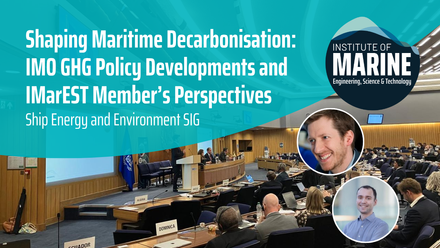
To learn more about GHG emissions and decarbonisation, watch the replay of the Ship Energy and Environment SIG webinar “Shaping Maritime Decarbonisation: IMO GHG Policy Developments and IMarEST Member’s Perspectives” and join the SIG.
Tell us what you think about this article by joining the discussion on IMarEST Connect.
Image: IMO HQ in London. Credit: Shutterstock