Scaling Ethanol as a Maritime Fuel: engine and fuel considerations
Extraction industries seeking to reduce their Scope 3 emissions are looking to maritime for help. Could new ethanol-powered Guaibamax vessels play a role?
Maritime can be a contributor to mining’s Scope 3 emissions, since bulk commodities are often transported by vessels. Shandong Shipping Corporation concluded an agreement with mining company Vale for new ethanol-powered Guaibamax vessels, which may help to cut carbon emissions by up to 90% compared to heavy fuel oil.
For Vale, which chartered the two 325,000 DWT bulk carriers, which are to be built by Beihai Shipbuilding in China, this could help decarbonise their Scope 3 emissions on their iron ore trade routes from Brazil to Asia.
The ships, due for delivery from 2029, will be powered by WinGD’s ethanol engines. Rather than designing a brand-new architecture, the Swiss marine power company adapted its established X-DF-M methanol engine platform.
“Our work on alcohol fuels began more than a decade ago, when we started investigating both methanol and ethanol as potential marine fuels,” says Leif Knipström, Senior Product Manager Methanol/Ethanol at WinGD.
The early studies showed both fuels could be viable for large two-stroke engines – although no engine is methanol or ethanol only as they are dual fuel with a pilot ignition system required for all modes.
“Because methanol and ethanol have many similarities, particularly from a combustion perspective, the X-DF-M platform provided a natural basis for an ethanol engine.”
“Adaption relates to the engine control, reflecting ethanol’s different lower heating value and combustion characteristics,” says Knipström. While there were technical considerations to factor in, relatively few changes were required for the wider fuel supply system.
This approach allowed WinGD to use proven technology while responding to growing interest in ethanol as a marine fuel.
Design challenges for alternative fuels
On the alternative fuel challenge, Knipström says “every new fuel requires detailed development to ensure it delivers the safety, efficiency and reliability expected in deep-sea shipping. Ethanol is no different.”
“Its combustion characteristics differ from conventional fuels and from methanol in some respects, requiring optimisation of the injection system and engine controls to achieve the desired performance and emissions profile.”
WinGD began investigating the potential of ethanol over a decade ago and built on that knowledge through the successful commercialisation of the X-DF-M engine. “The similarities between the two alcohol fuels meant that adapting the technology for ethanol was a logical next step rather than starting from a blank sheet of paper,” says Knipström. “As fuel availability develops in those regions where ethanol is produced at scale, we expect it to become another viable option within the industry’s future multi-fuel landscape.”
How scalable is ethanol as an alternative fuel?
The Guaibamax bulk carriers will mark the first time that ethanol will be used as the primary fuel on an ocean-going vessel. Dr Thomas Beard (FIMarEST), Clean Shipping Service Lead at BMT, says this is “a really positive step for the industry, especially as these are tagged as being multi-fuel (can use methanol and HFO and possibly conversion for LNG or ammonia). This is a first-mover and enabling multi-fuel usage de-risks any possibility of a stranded asset.”

Training for safe handling and operations will be essential for seafarer safety – as with all new fuels.
Openly discussing decarbonisation challenges
Collaborative networks in maritime support discussions around clean fuel challenges and solutions. Beard is co-chair of IMarEST’s Ship Energy and Environment SIG, which will soon release a questionnaire for members.
Want to get involved? Join the Ship Energy and Environment SIG today
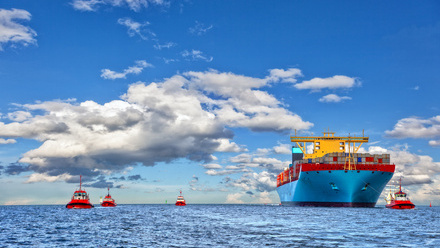
Main image: Ethanol-fuelled Newcastlemax VLOC Credit: CSDC (China Ship Design & Research Center Co,.Ltd)
Inline Image: Dr Thomas Beard, BMT
Credit: BMT
Tell us what you think about this article by joining the discussion on IMarEST Connect.