New IMarEST Fellow shares research and career insights in a digital maritime world
Michele Martelli, Associate Professor of Marine Propulsion Plant and Auxiliary Systems at University of Genoa, and recently appointed IMarEST Fellow, discusses how emerging professionals can prepare for an increasingly digitalised world
While studying naval architecture and marine engineering, Professor Michele Martelli cultivated his interest in programming, control systems and electronics on the side. A master thesis and PhD then offered freedom to combine these domains. Today Martelli is a specialist in integrated control systems for marine engineering, including propulsion plants and autonomous ships, and is Vice Chair of the International Ship Control Systems Symposiums (iSCSS).
This offers a nuanced perspective on the challenge the traditional maritime sector faces under rising digitalisation. “Because the lifetime of ships is from 25 to 40 years, new technologies take time to be widely used,” says Martelli, noting that the industry is now forced to make changes. “The whole community, starting from the designer, ship builder, ship owner, to the seafarer, needs to face that.”
Technology advances are outpacing the rate of change the sector is used to, which is typically a vessel life span. “We design a ship, we build it and need to operate basically with the same platform for at least 25 years,” he says.
Yet the challenge brings opportunity, especially for safety of life at sea and the environment. “Because we can optimise designs and operations and look to reduce fuel consumption and consequently, emissions,” he says.
Crew remain crucial to combat cyber threats
With digitalisation, however, come emerging cyber-risks, with GNSS, Radar, cameras and AIS vulnerable to being corrupted during a cyber-attack, leading to potentially serious consequences. “When you think about navigation in a narrow channel or crowded area, just a couple of 20 metres of wrong positioning can lead to collision or grounding,” he says.
Technical countermeasures can be put in place, but “specific training is needed to make people aware that sometimes you cannot rely blindly on what you see on screen,” he cautions. “My suggestion is that the crew on board need to practice particular drills for cyber-attack scenarios, to be trained in case of an incident.”
This is even more important when anticipating the autonomous ships of the future, where there may be few or no crew on board. “In that situation, people may rely on only the sensor and screen for monitoring ashore, so it’s even more important for the personnel to be trained and certified for conducting such an operation,” says Martelli.
Harnessing AI now and into the future
A similar concept applies to artificial intelligence (AI) use today. Professor Martelli encourages younger generations to use such digital technologies - but responsibly and critically. AI skills may be a future advantage but an over-reliance on LLMs, such as ChatGPT, comes with its own risks. Critical thinking in an increasingly digital world will be crucial, says the professor, who encourages early career professionals to have curiosity and continue studying for career development.
The value of engaging in the maritime community
Volunteering and networking with others in communities such as IMarEST can be a way of career and personal growth as well as being an opportunity to give back. That is partly what motivated Professor Martelli to apply for the fellowship. He’s also a fan of mentorship. “Sometimes a quick chat, an e-mail, or just support will make someone’s life easier,” he says. “So basically, the sense of impact is one of the main reasons to apply for the fellowship.”
Dr Martelli encourages aspiring fellows to actively engage, volunteer and share expertise within IMarEST. Engaging with the international community in particular can fuel personal development and career development in tandem. Sharing not just technical expertise but life experience remains invaluable in the maritime community as it faces new challenges like digital adaption.
Fellowship (IMarEST), the highest membership level at IMarEST, recognises professionals like Professor Martelli with high-impact, sustained achievements across marine engineering, science or technology. IMarEST actively welcomes existing members to upgrade their membership and apply for a fellowship, or seek mentorship along the way.
Interested in applying for IMarEST Fellowship? Find out more here
Tell us what you think about this article by joining the discussion on IMarEST Connect.
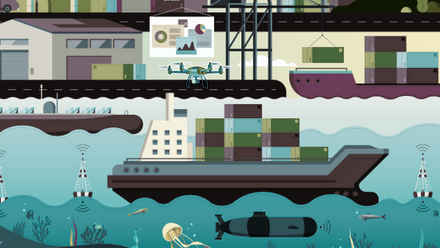
Image: A connected ship at sea. Credit: Shutterstock