Nuclear-powered cargo ships: what’s different this time?
As nuclear-powered vessels continue hitting the headlines, John Bensalhia looks at the potential benefits, difficulties and future outcomes of making such ambitions a reality
The concept of nuclear-powered cargo vessels isn’t new. Dr Thomas Beard, Clean Shipping Service Lead and Principal Marine Engineer at BMT, and Jake Rigby, Head of Innovation and Research at BMT, cite the examples of the NS Savannah, Otto Hahn and Mutsu, which were built in the 1960s and 70s but didn’t succeed commercially. “The operational and safety models simply didn’t work at the time.”
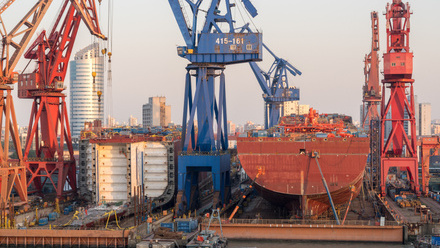
With the Jiangnan Shipyard now building a 25,000 container nuclear-powered ship, the pair wonder “What’s genuinely different this time?”
The answer lies in the reactor technology itself. The Jiangnan design being developed in China uses a Generation IV thorium molten salt reactor: low pressure, passively safe and reduced enrichment.
According to Beard and Rigby, this is a fundamentally different proposition from the reactors that went to sea 50 years ago and even from most land-based reactors.
“Gen IV designs embed passive safety from the ground up. They can shut down safely without external power or operator intervention, and that changes the commercial and regulatory calculus significantly. Enabling the reduction in size of the emergency planning zone around the reactor.”
There are still huge barriers, however. “Previous nuclear merchant ships failed not because the reactors didn’t work, but because the commercial and operational model around them didn’t,” explain Beard and Rigby. “Port access restrictions, crew training and certification requirements, insurance frameworks that couldn’t accommodate the risk profile, public opposition. Those structural challenges haven’t gone away, and they cannot be solved by technology alone.”
Regulation remains the biggest blocker. Jiangnan’s vice president acknowledged that there is currently no designated government authority to approve a nuclear commercial vessel and that’s in China, which has the most state-driven capacity to push this through quickly. “Internationally, the IMO’s nuclear merchant ship code dates to 1981 and requires fundamental overhaul,” explain Beard and Rigby. “This includes alignment of the regulations and wording between the maritime and nuclear sectors. Local regulations are currently a challenge as many ports and coastal states may simply refuse entry today, which immediately constrains route viability for what is, in commercial terms, a global asset class.”
Insurance and liability are closely-linked challenges. “Both nuclear and marine insurance frameworks will need to mature to support commercial deployment,” says Jez Sims, Technical Authority for Nuclear, Lloyd’s Register. “Progress will depend on clarity around operating models, allocation of liability, and clearly defined interface ownership between reactor vendors, shipyards, operators, and regulators. A proportionate, risk-based certification approach is essential to ensure credibility without imposing unnecessary conservatism.”
From a naval architecture and systems engineering perspective, design integration challenges shouldn't be underestimated. “The challenge in design is leveraging the experience in the naval sector whilst still ensuring that security classifications are not broken,” comment Beard and Rigby. “However, Gen IV reactors are different technologies and as such understanding the differentiators is fundamental.”
Societal engagement is another critical factor. Sims explains that while public acceptance of nuclear energy is currently higher than at any recent point, nuclear remains poorly understood by much of society. “As technologies targeting early 2030s deployment become clearer, and regulatory pathways more defined, there is an opportunity to engage transparently with the public and stakeholders. When integrated, operated, and regulated within a clear licensable framework, nuclear has the potential to be among the safest energy sources used in the maritime domain.”
Thomas Beard and Jake Rigby say that Gen IV's passive safety features represent a step change from the current operational nuclear reactors, citing the example of China’s thorium molten salt reactor in the Gobi Desert achieving stable operation in 2025 and wider research across the globe including at the historic US Oak Ridge National Laboratory.
“But the technology being ready and the commercial and operational model being ready are two different things, and both have to move together. The lesson of history is that a credible nuclear merchant ship programme requires the whole system around the vessel to change, not just the propulsion plant.”
BMT's research puts realistic widespread Gen IV surface ship deployment at 2050 to 2060. Beard and Rigby argue that what matters is the medium-to-long-term horizon. “China’s thorium MSR achieving stable operation last year is a genuine milestone, and China is clearly making a strategic push across nuclear cargo vessels, tankers and floating power generation.”
“But construction of the Jiangnan container vessel remains roughly a decade away at best, and global regulatory frameworks are nowhere near ready to support commercial operation.”
Mark Tipping, Lloyd’s Register’s Global Power to X Director, says that nuclear-powered vessels are likely to increase in number over the coming decades. “The technology offers compelling advantages for specific applications, and it is difficult to see those advantages being ignored indefinitely.”
The key question, he says, is not whether nuclear-powered ships will emerge, but at what scale and pace.
Tell us what you think about this article by joining the discussion on IMarEST Connect.
Image: A propeller. Credit: Shutterstock