Global shipbuilding: who is striving and who is thriving?
Major global shipbuilding nations China, South Korea and Japan are expected to continue their market dominance, but the likes of India and United States are actively playing catch-up
The global shipbuilding marketplace – of which about 85% is understood to be handled collectively by the Asia-Pacific region – was valued at US$115 billion in 2024. Predictions of its worth reaching US$140 billion by 2030 are only expected to provide further stimulus to the sector, notes UCL Energy Institute Professor of Energy and Transport, Tristan Smith.
“The fundamental drivers of demand for shipping are on growth trajectories – wealth and population size,” Smith explains.
Professor Smith considers the three leading shipbuilding nations continue to retain certain advantages in the sector, with China even taking new strides forward.
“China has competed on wages, Japan and increasingly Korea have competed on expertise and quality. Similarly, Europe is still competitive at the high end for some vessel types (cruise).
“Whilst perhaps a couple of decades ago, some might have only looked to China for simpler lower-risk designs – for example, conventionally-fuelled bulk carriers – it is now taken seriously for state-of-the-art designs including ammonia dual-fuel containerships, LNG and methanol dual-fuel vessels being in their order books.”
That said, Professor Smith says although there may not be any “overnight” threat to the position of dominant shipbuilding nations, he equally observes “it’s not a given that that concentration is sustainable”.
“Countries like India are also keen to have significant shipbuilding capacity. And United States policy has moved to increase protectionism and incentives for domestic production.”
According to the Global Maritime Trends 2050 report from Lloyd’s Register, “Africa countries could become the dominant supplier of seafarers [by 2050].”
“This does not mean that there aren’t also potential trends that could be counters to the growth drivers – like reshoring [or the] circular economy. However, we still have a fundamental physical imbalance between the centres of where raw materials [such as] food, energy commodities, [and] ores [are and] the centres of manufacturing and the centres of consumption,” Professor Smith continues.
“With continued inequality, it will continue to make sense to extract in one part of the world – even if it’s recyclate – process in another and consume in another. With increased wealth and population comes increased consumption of ‘stuff’ and therefore increased demand placed on the global supply chains that extract, move, process, move, sell – and therefore on shipping.”
Will the race towards decarbonisation make a difference?
Professor Smith does not expect shipbuilding developments related to emissions reduction drivers to be a notable influence on market dominance.
“Once experience is gained from initial designs and codified in design practice [and] classification rules, the fundamental systems that need to be designed and built do not differ significantly from conventional-fuelled ships.
“The exception here is likely nuclear-powered shipping, which would then require specific expertise which is not available in all countries and may significantly advantage countries with that expertise in shipbuilding."
In addition, Professor Smith does not expect any potential growth in electric ship battery systems as a complement or replacement for conventional engines to pose as a notable disrupter.
“If China – the world’s battery expert and supply chain controller – wasn’t already a major shipbuilder, then yes. But given it is dominant in batteries and shipbuilding, the pattern is already rather stable and China is in [the] process of fully exploiting this competitive advantage in multiple electric ship designs.
“It is also clear, as in automotive, that importing Chinese batteries is not an obstacle to others being able to provide battery-electric designs. But then the competitive advantage is less nationally controlled – unless there is a change in China’s comparative [dominance] in battery/electrification technology.”
Ammonia predicted to be ‘heavily dominant’
According to Professor Smith, analysis by the UCL Energy Institute indicates that ammonia dual-fuel will become a “heavily dominant propulsion technology, likely as soon as the 2030s”.
“This just comes down to the relative cost competitiveness of a range of different fuels – many that work in the transition – but ultimately cannot scale to large volume production as cost-effectively as ammonia,” he states.
“Extrapolating from this, the future market share of China, Korea, [and] Japan and their future competitors – for example, perhaps India, maybe others [in] Africa – will therefore depend on how competitive and how quickly they can produce, engineer and cost-reduce ammonia dual-fuel propulsion in a range of different ships.”
Tell us what you think about this article by joining the discussion on IMarEST Connect.
Image: Shipbuilding along banks of River Huangpu in Shanghai, China. Credit: Shutterstock.
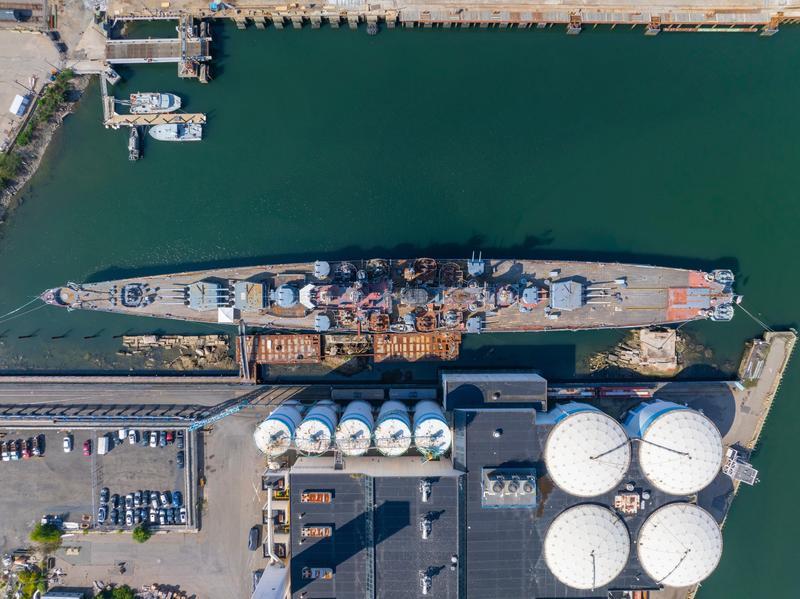
Inline image: USS Salem CA-139 heavy cruiser at Weymouth Fore River in Quincy, Massachusetts MA, US. The ship was built in 1949 and retired in 1959. Credit: Shutterstock.