UK and US ‘to build’ floating nuclear power plants
Nuclear power in spotlight as the search for clean, reliable power in shipping continues.
November’s World Nuclear Exhibition (WNE) in Paris emphasised the part that nuclear energy could play in meeting the growing demand for clean energy, with “global nuclear electricity generation set to achieve a record high in 2025,” according to a report on the event in World Nuclear News.
Connected to this potential transition, floating nuclear power plants (FNPP) was raised in a recent trans-Atlantic partnership announcement. Mark Popplewell, Managing Director, NuclearRisk Insurers Ltd, said that: “Unified regulatory clarity reduces uncertainty, enabling insurers to underwrite with confidence.
“Development of a bilateral liability convention between a strong pair of 'frontrunner' nations will further underpin this confidence and make a dedicated nuclear corridor possible with early prototypes.”
The partnership between the UK and US also cited the possibility of producing nuclear-powered merchant vessels. NEMO (Nuclear Energy Maritime Organisation) believes that the collaboration will be geared towards developing regulatory, safety, and operational frameworks for maritime nuclear technologies at a more urgent pace.
NEMO has said that its next steps will include the promotion of alignment in training and capacity building to ensure the workforce is ready to meet the technical and regulatory demands of maritime nuclear energy. In addition, it will engage with US and UK regulators to provide technical input on draft regulations, standards, and guidance in relation to floating nuclear platforms and nuclear propulsion.
Public perception needs to change
Meanwhile, Norwegian classification society DNV's latest report on the subject has suggested that changing environmental requirements are “reigniting interest” in using nuclear energy for maritime decarbonisation.
The report, ‘Maritime nuclear propulsion: Technologies, commercial viability, and regulatory challenges for nuclear-powered vessels’, however, added the caveat that there is still much to be done with regards to public perception of nuclear power. The paper argued that public opinion could change on account of “advances in automation, digitalisation and modular design” which are identified as “critical enablers” of safety and security.
Knut Ørbeck-Nilssen, Maritime CEO at DNV, said that while nuclear energy has the potential to play a role in the maritime energy transition, much work still needs to be done to: “Overcome technical, regulatory, and societal challenges, including public perception.
“This will require co-ordinated global action, technological innovation, and closely aligned regulatory frameworks.”
The need for clear regulatory frameworks was echoed by classification society, Lloyd's Register, which has produced a document that discusses safe and responsible use of nuclear technology.
Mark Tipping, Lloyd's Register’s Global Power to X Director, said that nuclear energy has, “the potential to transform maritime, providing a scalable and zero-carbon energy source that can accelerate the industry’s energy transition.
“However, its adoption requires clarity, collaboration and trust across regulators, operators, insurers and wider society.”
Nick Tomkinson, Senior Partner at Global Nuclear Security Partners, added: “Maritime nuclear will only succeed when safety, security and safeguards are considered together from the start.”
He concluded that the Lloyd's Register guidance document, Navigating Nuclear Energy In Maritime, will help, “first movers align maritime and nuclear frameworks, apply goal-based approaches where prescriptive rules are absent, and build the confidence required by regulators, insurers and the public.”
Tell us what you think about this article by joining the discussion on IMarEST Connect.
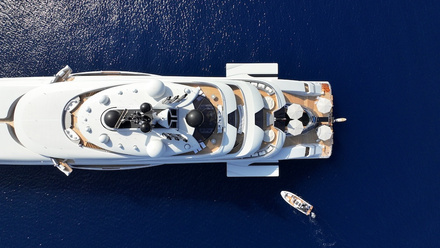
Image: The world's first – and only working - floating nuclear power block Akademik Lomonosov, Russia. Credit: Shutterstock.