Understanding hydrodynamic loads
In offshore renewable energy systems, hydrodynamic characterisation is key for reliability and safety
Offshore energies have been a great source of research for naval architects and marine engineers, with the wind industry being a particularly hot topic, well known for its technical challenges.
These multi-physics systems extract energy from wind, waves or currents some kilometres offshore, delivering energy back using export cables.
Several systems and different fields of engineering play key roles in the correct design of these devices. While aerodynamic performance has long been the focus of turbine performance, hydrodynamic characterisation plays a fundamental role in ensuring the reliability, safety, and efficiency of offshore wind energy systems.
Understanding and mitigating these hydrodynamic loads is essential for the structural integrity, dynamic stability, and long-term performance of these multi-physics systems.
How it works
Hydrodynamic loads on marine renewable structures are mainly governed by two physical effects: potential and viscous flow. The governing regime will be determined by the relative size of the structural members towards the incident wave.
While inertia forces — described in the first term of the Morison equation— are proportional to the fluid’s acceleration and dominant in large bodies, drag forces arise from viscous effects and are proportional to the square of the flow velocity, dominating cases where structural elements are considered slender, where flow separation occurs. Among these steady components one can also find current and wind loads.
Beyond these, floating renewable structures are exposed to oscillatory and nonlinear dynamic loads. Waves can induce first and second order loads, generating harmonic motions or low-frequency oscillations and mean drift. While intuitively one could think that first order motions would be the most significant ones, these slow-drift responses are crucial for moored systems, which could lead to large offsets if not considered adequately.
Finally, extreme sea states can induce the structure to slamming loads, ringing or vortex-induced vibrations, which could result in severe structural damages, having a significant contribution to the fatigue life of elements such as mooring lines or dynamic cables.
The importance of hydrodynamic modelling
The correct identification and characterisation of all the above enable engineers to have precise hydrodynamic models, being able to assess how offshore structures respond to real sea conditions.
Small inaccuracies in load estimation can lead to large design inefficiencies - overestimation results in unnecessary weight and cost, while underestimation threatens structural safety and operational lifespan.
In bottom-fixed turbines, hydrodynamic forces govern the fatigue life of monopiles and jackets, especially near the seabed where vortex-induced vibrations and cycles of bending moments occur. In floating systems, hydrodynamics governs the global motion of the platform and the tension in mooring lines and cables.
Strategies for load mitigation and motion control
Once these loads have been correctly understood and modelled there is a series of mitigation strategies that can be implemented. These can range from structural modifications to integration of appendices, or advanced control systems to enhance stability and reduce the effects that the environmental loads might have on these giant structures.
These loads play a crucial role in the design of offshore devices, from the early design stages setting up the structural configuration, modifying and adjusting natural periods to avoid resonance effects, to the inclusion of appendices such as heave plates or bilge keels to enhance stability and cancel wave excitation loads, as well as the design of the mooring lines itself, especially significant in the definition of stiffness and damping of the whole system.
More detailed and tailored solutions rely on motion-control systems, such as ballast control systems —both active or passive— in floating structures or scour protection in bottom-fixed solutions. Additionally, in the case of vessels, dynamic positioning (DP) systems are commonly used to keep the position during the offshore operations.
Finally, electrical subsea systems, dynamic power cables and umbilicals are also directly influenced by hydrodynamic effects. Their design includes auxiliary components like floaters, bend stiffeners, and bend restrictors that protect against excessive curvature and fatigue. Floaters help to redistribute buoyancy forces and modify the cable profile, while bend stiffeners and restrictors ensure safe bending radii near connection points.
This article represents the views and thoughts of the author, and not necessary of IMarEST.
Jose Luis López is a naval architect currently based in the Netherlands, specialising in offshore renewable energies and hydrodynamics.
Tell us what you think about this article by joining the discussion on IMarEST Connect.
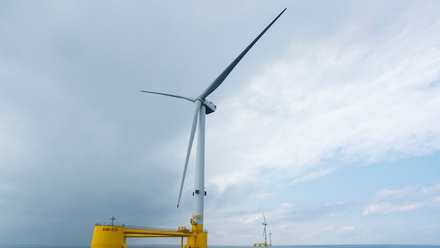
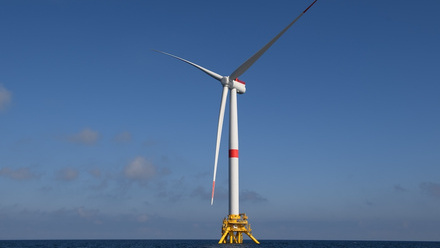
Image: offshore wind farm and energy platform in open sea. Credit: Shutterstock.