The Titanic - the engineers’ story
Whilst the sinking of the Titanic has been widely examined, books, films and documentaries tend to focus on the passenger experience, evacuation, or command decisions on the bridge. Much less attention has been paid to the engineering that shaped the ship’s final hours, particularly as none of engineers themselves survived the sinking.
One hundred and fourteen years on, Martin Shaw, 120th president of the IMarEST and chair of the Institute's History Society, explains how members have been piecing together the story of the engineers on board.
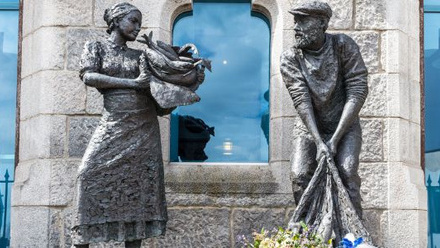
The IMarEST has long remembered the engineers of the Titanic. The Institute of Marine Engineers, as it was then known, funded the Engineers’ Memorial to the Titanic in Southampton, the city from which the vessel sailed. However, in the History Society we identified that there was very little written on what was happening below deck.
We set to work exploring this lost story on the IMarEST Connect forum, where members come together to discuss subjects of interest.
The Ship and its design
The ‘unsinkable’ Titanic was designed to remain afloat with up to four of its watertight compartments flooded, and this has often been mentioned in the stories and indeed the film. Unfortunately, during the sinking, the forward boiler room also flooded taking the total number of flooded compartments to five. That made the end inevitable.
In addition, the watertight bulkheads did not extend to the main deck. As water levels rose and the ship trimmed by the bow, flooding was able to overtop successive bulkheads and propagate aft.
The collision
When the Titanic collided with the infamous iceberg, five of the six boiler rooms were operational. The aftermost boiler room, No. 1, adjacent to the engine room, was not being used as it was primarily used for port load and was not required for propulsion.
Boiler Room 6 was abandoned shortly after the collision and the watertight door sealed. Evidence suggests it took around an hour for water to rise to a level where it overtopped into Boiler Room 5, which was then also abandoned. As the angle of trim (caused by the ship sinking at one end) increased, the rate of overtopping accelerated.
There is an interesting theory mentioned in the wreck commissioners report that if the watertight doors had been left open then the ship would have remained more level and stayed afloat longer. But that’s another story.
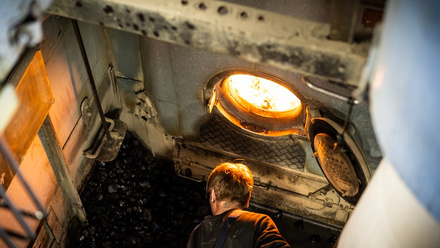
Around thirty minutes after the collision, the main engines and auxiliary machinery were undamaged but stopped. Boiler Rooms 2 to 5 remained under fire, and steam from these boilers continued to supply the electrical generators located aft of the engine room. Electrical power remained available to all spaces not affected by flooding, although some re-routing of circuits may have been necessary.
This helps to explain contemporary accounts of lighting and electrical services continuing for much of the evacuation as well as the role of engineering systems in supporting wider shipboard operations under deteriorating conditions.
Where were the engineers and stokers?
The Titanic operated on a three‑watch system, meaning that approximately two thirds of the firemen, stokers and trimmers were off watch at any given time. This system may explain why around sixty firemen and stokers survived, and there is no record of any
being lost during the flooding of Boiler Rooms 5 and 6. Stokers would have been in boiler rooms two to four, but it is unlikely that full manning would be required to power the generators.
Also, immediately after the collision the stokers messdeck was flooded and all off duty stokers were ordered on deck, so it seems likely that of those who died many would have got on deck but not into a lifeboat. The off-watch stokers may have been involved in preparing the lifeboats and may have crewed them thus securing a place.
Moving on to the engineers and engine room ratings, it is well known no engineers and few engine room ratings survived and this requires more thought. Once more with the three-watch system, in the region of one third of the engineers would have been below before the collision. These people would have mostly in the main engine room but also spread about several machinery spaces and boiler rooms.
As no engineers survived it may be that none got on deck. The most plausible reason for this is that all the engineers were either called or went to the engine room and remained there to ensure that the generators and other auxiliaries operated, and that the various bilge pumps were operating correctly.
Subsequent examination of the wreck by Robert Ballard and his team in 1985 supports conclusions reached in the Wreck Commissioner’s Report that the hull failed in the region of the engine room, a recognised structural weak point. If this is the case, the event would have been sudden and catastrophic with no chance of survival.
Reflection
For today’s marine engineers, the events below decks of the Titanic provide a case study in professional responsibility under extreme and evolving conditions. Decisions were made not in isolation, but in the context of system capability, structural limitations and the needs of the ship as a whole.
It is a sobering story and one that feeds nightmares that generations of marine engineers, particularly in wartime, have had to face since. The bravery of these marine engineers in the first few decades of our profession should be an inspiration to us all. And it is out of respect to them that we must learn the engineering lessons of the past