From research vessel to global symbol: the Rainbow Warrior story
From an Aberdeen research ship to an idling rust bucket to a symbol of environmental crusading, the Rainbow Warrior is a little ship that made a big impact
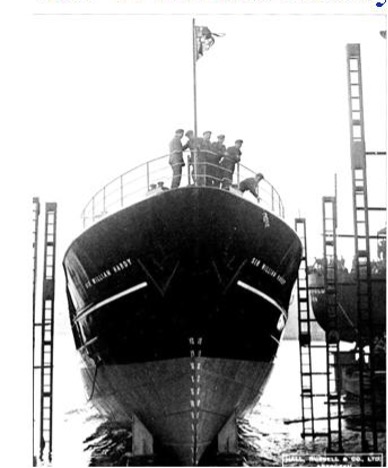
It was 6th July 1954 and the workers at Hall Russell shipyard laid the keel for their latest contract: building a new Research Vessel for the UK Government Department of Scientific and Industrial Research (DSIR), with the hull form based on a conventional trawler design. In 1951, Hall Russell built a smaller ship, Cape St. Mary, (242 GRT) for the West African Fisheries Research Institute, paid for by the UK government. On the 29th November of the same year their latest newbuild was on the launch-ways, and with the smash of a bottle on her bow, Mrs G. A. Reay, wife of the superintendent at Torry Research Station, named her Sir William Hardy after the British biologist and food scientist (1864 to 1934). Little did they know that this relatively small ship would in later life be given a name that would be known all over the world.
The Sir William Hardy was the first ‘diesel-electric’ trawler built in the UK. This at the time was an innovative design, using a diesel engine to run a generator, which then provides the power to an electric motor which turns the propeller. Nowadays this is standard design on most ships.
Government records state that during the engine room trials with Hall Russell, it was found that there was insufficient air entering the engine room when the propulsive machinery was operating at normal power resulting in higher temperatures than anticipated. This problem took six months to resolve and an additional cost of around £3,000. Costs included a study to determine how much ventilation was required, and the design and installation of a larger ventilation system.
Registered in Aberdeen with Fishery registration number A45, the ship worked for the Torry Research Station, Aberdeen, which was established in 1931 to study how best to improve the preservation of fish.
In 1977, after being decommissioned by MAFF, the ship was lying idle, berthed in the Isle of Dogs, London, when it was found there by Denise Bell of Greenpeace (who was later to become a crew member). Her instinct told her that this ship was perfect for what they needed, and Greenpeace put an offer in to buy it for £42,725. The price was later renegotiated down to only £36,872 as per the bill of sale dated 26th January 1978. Although referred to as a ‘rust bucket’, Greenpeace volunteers managed to make it ship-shape in only 3 to 4 months, so perhaps the rust was only cosmetic - government ships are usually well maintained. As Greenpeace’s first ship, this former rust bucket was re-launched on 29th April 1978 and renamed the Rainbow Warrior.
The name came from Greenpeace’s Paris office where a founding member Remi Parmentier took inspiration from Hugo Verlomme’s book Mer-mère and liked the idea of “Le Combattant de l’Arc-en-ciel”. Susi Newborn, of Greenpeace UK, simplified Parmentier’s Gallic to Rainbow Warrior. Many believe her name was given after a North American Cree Indian prophecy “When the world is sick and dying, the people will rise up like Warriors of the Rainbow”. However, this connection was made a few years after the naming ceremony. The ship was painted with a rainbow pattern on the hull, a dove of peace carrying an olive branch on the bow to symbolise Greenpeace’s mission, and on the funnel a motif of two whales forming the infinite cycle of nature.
On 29th April 1978, Rainbow Warrior sailed out of London onward to Amsterdam, then Copenhagen, and then to Hamburg, where it was greeted by large crowds at each port. In Hamburg, local environmentalists lowered a piano onto the deck, rigged up some spotlights and held a welcoming party and concert on her deck with a popular German jazz band. Quite appropriate as some of the men who built this ship played in Hall Russell’s male choir.
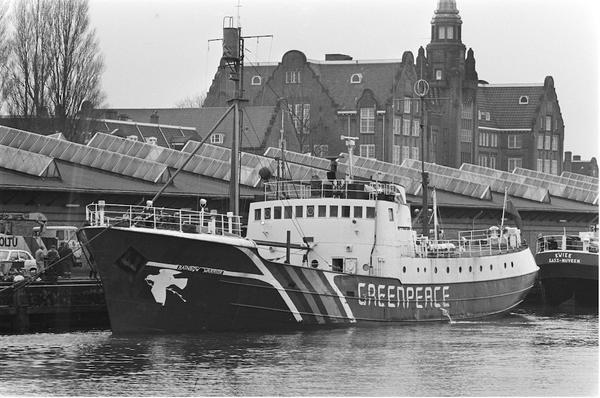
The first real mission was to protest the hunting of whales by Norwegian and Icelandic whaling fleets. The aim of the campaign was to highlight the plight of the whales and attempt to force the International Whaling Commission to introduce a moratorium on whaling. Ironically, during a refit in 1981, it was discovered that some of the hydraulics were filled with whale oil, which had been fitted before Greenpeace’s purchase of the ship, probably when built.
In 1985, it had sails fitted, with a new mission to protest nuclear testing in Moruroa Atoll in the French Polynesia, South Pacific. The plan was to escort a flotilla of smaller yachts from Auckland in New Zealand to the island and monitor past and present impact of nuclear testing. It was revealed later that the French government knew all about Greenpeace’s intentions and on 10th July 1985 their Intelligence Service agents took action to stop the planned protest and planted explosives on the hull while berthed in Auckland Harbour. Just before midnight, an explosion rocked the ship, and it began taking water. Most of the members of the 11-man crew left the ship only to hear a second explosion. It is recorded that a French scuba diver planted two packets of plastic-wrapped explosives to the ship’s hull; one near the propeller, and the second outside the engine room. Sadly, 35-year-old Portuguese photographer and father of two young children Fernando Pereira never made it off the ship and died during the attack. The hole in the hull adjacent to the engine room was eight feet in diameter.
The French initially denied responsibility; however, the New Zealand police apprehended two French agents, Major Alain Mafart and Captain Dominique Prieur, and charged them with arson, conspiracy to commit arson, wilful damage, and murder. The French Defence Minister Charles Hernu resigned when the truth about the scandal became public knowledge.
On 22nd September 1985, French Prime Minister Laurent Fabius held a press conference and admitted: “Agents of the French Secret Service sank this boat. They acted on orders.”
The two agents were brought to court and both pleaded guilty to manslaughter. They were both sentenced to ten years in prison, but they served less than three years before being freed by the French government.
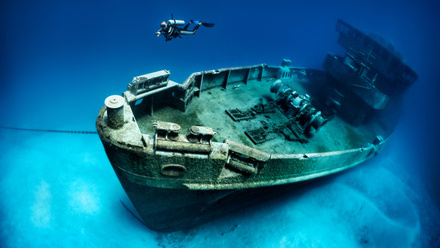
Rainbow Warrior was re-floated for forensic tests and later deemed uneconomical to repair. On the 12th December 1987, it was scuttled in Matauri Bay, near the Cavalli Islands, New Zealand (34.9748°S 173.9349°E) and now forms an artificial reef frequently visited by divers.
The French government wrongly thought that sinking the Rainbow Warrior would stop Greenpeace protesting its nuclear testing in the Pacific, but it had the opposite effect. The loss of the ship and the death of Fernando Pereira put Greenpeace on the news worldwide and strengthened support against nuclear testing in the Pacific (which ceased in 1996). The Aberdeen built trawler played a part in the Greenpeace story, which started from a small group of volunteers in 1971 to now being represented in 55 countries and having an incredible 2.8 million supporters worldwide.
| Statistics | |
|---|---|
| Hall Russell Yard No.: 846. | Registration No. A45. (A for Aberdeen). |
| Gross Registered Tonnage (GRT): | 418 tons |
| Length: 40m (131ft, 3in) | Depth: 4.6m (15ft) |
| Breadth: 9m (27ft ,7in) | Propulsion: 2 engines |
| Speed: 12 knots | Accommodation: 16 crew members and 4 scientists |
| Cost: £250,000 approx | Sea Trials: 30th March 1955 |
| Delivery Date: January 1956 | Decommissioned by MAFF: 1977 |
|
MAFF - Ministry of Agriculture, Fisheries and Food |
|
Like this content? Join our History Society.
Why not attend one of our webinars?
Tell us what you think about this article by joining the discussion on IMarEST Connect.
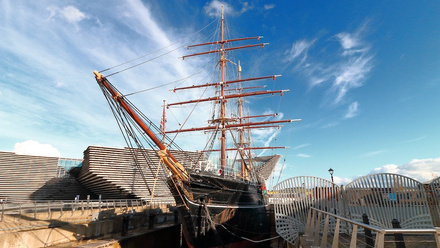
Main and inline image: Rainbow Warrior berthed in Amsterdam in 1981. Credit: Hans van Dijk.
Inline image: Launch of the Sir William Hardy, Aberdeen, 29th November 1954. Credit: Hall Russell archives.