Beer - and its unlikely role in engine room efficiency
Beer was a staple on ships in the 17th and 18th Centuries. We take a dive into the IMarEST library to find out why
In days past, for a ship's engineering team beer was arguably as essential as fuel oil. For those required to entomb themselves in the (usually) noxious environment of a ship's engine room, knowledge that a chilled beverage or two was waiting above decks was an essential palliative.
A rose-tinted view of history? What can be learned from the IMarEST online library? Somewhat surprisingly, perhaps, there are over a hundred documents in the library that reference 'beer' in some way. To begin my research, I picked up John Maber's 1979 paper 'Beer in the RN', published in the Journal of Naval Engineering (JNE).
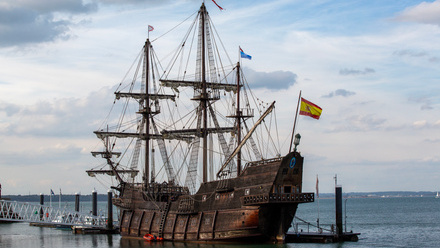
Maber observes that, prior to the routine fitting of metal water tanks on ships from around 1815, potable water was only available for the first few days at sea. Thereafter, beer was the only 'safe' liquid to drink albeit likely not of great quality. Indeed, in the 17th Century an allowance of a gallon of beer per day was prescribed for each sailor on Royal Navy ships; any wonder sea shanties became ubiquitous on sailing ships! Moreover, given this was pre-Industrial Revolution, the delivery of sufficient beverage to the Navy through a network of breweries and contractors clearly represents a triumph of logistics centuries before Jeff Bezos came along. Which led me to 'The Naval Engineer in War', penned in 1945 by Captain I. G. Maclean RN, likewise published by the JNE.
In his paper, Captain Maclean describes the essential role played by RN marine engineers during the Second World War, notably, the delivery of victualling services for the highly mobile operations that characterised conflict in the Pacific. As he put it: 'If the Napoleonic army "marched on its stomach", the modern Navy fighting a tropical war [...] needs beer and ice-cream'. Adding, 'The provision of the machinery for this falls to the lot of the engineer.'.
Alas, the brewery ships proposed by Captain Maclean do not appear to have seen the light of day. Perhaps as a compromise, 'Brewing in H.M. Ships' usefully explains the techniques for successful beer production in an engine room, presumably the Chief Engineer serving as expert brewmaster in addition to his (or her) other skills. Which does not necessarily explain the relationship between engineers and beer as consumers.
The answer may lie in Commander Aylen RN's 1953 JNE paper 'Steam and the North West Passage', a review of the ill-fated 1829 voyage of the Victory (not that one) to navigate the North West Passage from the Atlantic to Pacific under the command of Captain John Ross RN. Such was the grim nature of conditions below decks on early steamships, Ross insisted stokers be allowed a double quantity of beer. Not through any concern for their welfare per se. Rather, as recorded in his 1828 Treatise on Navigation by Steam, a suitably motivated stoker 'will not only keep a better fire, and a more steady heat on the boiler, [he] will save in fuel, what would soon pay the wages of the whole crew.'.
So there you have it: beer, and its relationship to marine engineering, was the secret sauce that shaped modern shipping. Without beer, where would be the intermodal logistics that underpins the global economy and recognition of the need to 'think outside the box' to establish alternative approaches to reduce fuel consumption. But beyond that I suggest there's a deeper and more prescient conclusion to draw.
Modern ships are mostly dry. With good reason too, given the deleterious impact of alcohol on human performance. This was seldom critical with the relatively simple technology and large crews that characterised ships through to, give or take, the 1960s but certainly is not so for today's highly sophisticated, lean-manned vessels. Nonetheless, while the supply of beer to seafarers can no longer be considered appropriate, its historic role underpins the essential link between the investment in crew wellbeing – the readily achievable access to broadband internet a present-day equivalent – and enhanced operational efficiency. In that regard, nothing has changed.
Like this content? Then please do join the History Society – new members always welcome.
Tell us what you think about this article by joining the discussion on IMarEST Connect.
Image: Worker on steam ship, New Zealand. Credit: Shutterstock