From sail to steam: Aberdeen’s fishing revolution
Aberdeen’s first steam-powered fishing vessel was an unsuccessful experiment. Yet within 15 years, steam had begun to transform the city’s fishing fleet, bringing prosperity to local shipbuilders and changing the way fishermen worked.
In July 1868, world-renowned sailing ship builder Alexander Hall & Co. launched a small steam drifter called the Frederick, (23 tons) capable of 6 knots. This is a very early date using a steam engine on a fishing boat, and the first built in Aberdeen. Frederick wasn’t a success and was up for sale a year and a half later – unsurprisingly, the local fishermen saw this and opted to continue with sail. Note the first steam-driven vessel built in Aberdeen was the paddle steamer Queen of Scotland, built by John Duffus & Co. in 1827 for the coasting trade.
In 1882, a Tyneside-built wooden-hulled paddle tugboat, the Toiler (118 tons with a 60nhp steam engine), which had been launched by Lancelot Liddle, Willington Quay in August 1875, was bought in Dublin for £1,500 (roughly £160,000 in 2025 money). The purchaser was Robert Brown of Aberdeen, who converted the vessel at Footdee for use as a trawler. On Toiler’s first fishing trip, it sold its catch for £200 (£21,200 in 2025), which was a very successful catch at the time. It is said the vessel paid for itself in its first-year trawling. Its success was seen by other Aberdeen fishermen and word quickly spread around the town and further afield, creating a huge interest in steam-driven fishing vessels.
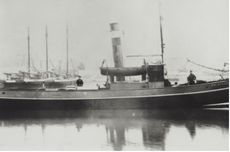
Steam Tug ‘Primrose’ (ex ‘North Star’) on the Gloucester and Sharpness Canal.
(Canal & River Trust)
Fifteen-years after the launch of the unsuccessful Frederick, spurred on by the success of the Toiler, the steam-driven trawler North Star was launched in September 1883.
The North Star (130 tons and measuring 101’ long x 19’ breadth x 10’2” depth of hold), registered at Aberdeen with fishing registration number A393, was the first successful steam-driven trawler built in Aberdeen. Built by John Duthie, Sons & Co, Footdee for William Pyper & Co, Aberdeen, her steam engine (2-cylinder compound, 19” & 38” x 27” stroke, generating 62nhp), was built by Hall, Russell & Co. The hull dimensions were very similar to that of the steam tug Toiler, giving it a larger beam than the hundreds of fishing boats that followed, as they were a bit more streamlined to enable a higher top speed.
Hundreds of steam, and later diesel driven drifters and trawlers built in Aberdeen followed due to the huge growth in the fishing industry. Local shipbuilders John Duthie, Sons & Co, John Duthie Torry Shipbuilding Co, Alexander Hall & Co, Hall, Russell & Co, and later John Lewis & Sons, all benefitted from the boom in the fishing industry. This boom peaked in 1907, when in this year alone Hall Russell & Co built 27 fishing vessels, taking the total built in the city that year to 66. Local press articles reported double launches and on one occasion three new fishing boats were launched on a single day to the cheers from large crowds of spectators.
While sailboats remained in use for another two decades, it was clear steam vessels had the advantage. Although more expensive to initially purchase, steam power allowed the fishermen to get their catch back to port quickly, which was especially important for herring catches that went off quickly, and as a result made them more profitable.
In 1903, the North Star was bought by the Florence Tugboat & Salvage Co of Middlesborough, renamed Primrose and converted to a tug. It was eventually sold to be scrapped 31st December 1914, 31 years after launch. Frederick was offered for sale in 1870 but then disappears from the records while the Toiler sank on April 1st 1887 during a gale in the Moray Firth.
In comparison, local North East boatbuilders were initially very slow in receiving orders from local fishermen. It was 1903, 20 years after the launch of the North Star, before W. & G. Stephen in Banff built their first steam drifter the Norseman, and it was 1904, when another Banff boatbuilder, Stevenson & Asher, launched their first steam drifter, Reliance. Aberdeen’s shipbuilders had again led the way.
If you enjoyed this content, why not join the History Society? New members always welcome.