Deadly fall highlights hidden dangers of shipyard maintenance
While undergoing maintenance in the Syros shipyard in Greece, the Equinox Seas bulk carrier was the scene of a deadly fall after a worker entered a taped off zone unaware of the hazards
A ship is not inherently safe in the controlled environment of a shipyard. In fact, a shipyard is more akin to a construction site – but one that can also sink. Accidents abound during maintenance. In recent years, vessels have sunk or burst into flame while alongside in yards, causing the deaths of not only crew but shipyard workers. Late last year, ten workers were killed and 18 injured in Batam, Indonesia, when an oil tanker caught fire while they attempted to repair it.
On 17 April 2023, the bulk carrier Equinox Seas was undergoing maintenance at a shipyard in Syros, Greece,when a somewhat less dramatic - but no less deadly - incident took place.
What happened
Equinox Seas called for routine maintenance at the Syros shipyard in Greece in March 2023, and by mid-April, work was well underway, including the removal of an engine room ventilation fan. This work was conducted inside a ‘fan room’ protruding from the upper deck – a small structure not much larger than a portable toilet, with a vented access door, and linked to the engine room by a 10m vertical ventilation shaft.
When the shipyard personnel began their work in the fan room, they installed black and yellow hazard tape across the entrance to indicate work was underway inside.
On the morning of 17 April, crew were engaged in general cleaning and preparation for the vessel to depart the shipyard. In the early afternoon, a fitter – reportedly with no particular task or work relating to it –passed a tape barrier and entered the fan room.
Inside was the fan pedestal – a round tube of some 1.2m in diameter – which led to the open ventilation trunk, a rectangular shaft measuring 1.6m wide and 1.67m deep. Inside the fan pedestal tube was a fire-damper, a remotely activated disk that that can swivel to close the tube and cut it off in the event of a fire. The damper’s mechanical actuator had been disconnected by shipyard engineers, leaving it to spin free.
Half-covering the entrance to the fan pedestal was a crude wooden pallet. With the fan removed for overhaul and rebalancing by the shipyard team, the lone fitter could have looked down from the rudimentary pallet to see the fan pedestal tube, partially repainted; and inside it, the fire-damper occluding the view of the deep shaft beneath.
Perhaps it was curiosity. Investigations failed to reveal why the fitter entered the fan room, and there was little evidence of any particular work to be undertaken there.
Perhaps he lost his footing, or mistook the partially-closed fire damper for a solid surface. Investigators found that with the pallet not in any way secured to the lip of the fan pedestal tube, stepping on one side of the pallet could have shifted it into a position where one corner could suddenly have come loose, tipping him into the hole. Either way, he fell into the fan pedestal tube and onto the fire-damper, which rotated and sent him plunging into the open shaft, falling ten metres down toward the base of the trunk.
It was impossible to determine whether he fell entering feet- or head-first. On this occasion he was not wearing his safety helmet, but the UK’s Marine Accident Investigation Bureau (MAIB) indicated it would not have made a difference to his fate.
The emergency response was prompt, with the incident quickly reported and alarms raised, but when the fitter was rushed to hospital with significant skeletal trauma, he was later pronounced dead.
Outcomes
MAIB investigation identified various failures. Though it might be sufficient to satisfy an inspection, the length of hazard tape across the hatch entrance did not present a physical barrier to access, and did nothing to stop the fitter entering the fan room. Some flimsy tape, in this instance, was all that stood in the way of a lethal drop.
The tape itself did not specify the nature or severity of the hazard – from the outside, it might have demarcated wet paint. Neither was there any signage to indicate the risk, or anything to denote restricted access.
Communication between shipyard personnel was insufficient to warn its workers about the hazards created by ongoing work. The vessel’s safety management system was not effective in a shipyard repair scenario. Though the vessel’s presence in a shipyard blurs the lines of responsibility, it ultimately rests with the ship’s master.
As a result of the accident, actions were taken to improve safety management. The shipyard has been recommended to update its systems to ensure that risks created by its activities are effectively controlled and communicated. The vessel’s management company has also revised its safety procedures to better address the specific risks associated with a shipyard repair context.
Tell us what you think about this article by joining the discussion on IMarEST Connect.
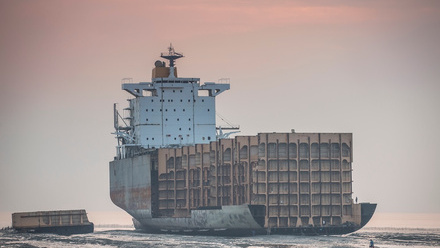
Image: Syros shipyard in Greece. Credit: Shutterstock.