Predicting fracture and failure in marine structures
How peridynamics can help naval architects and offshore engineers tackle the limits of conventional modelling
Ships and offshore platforms operate in harsh, highly variable environments. Safe operations require accurate prediction of fracture and failure, but this type of modelling can be very challenging in an environment where waves, wind, currents and temperature fluctuations generate random loads.
Yet robust predictive tools matter more than ever now. Climate change is already exposing vessels and offshore infrastructure to more severe storms, higher waves and shifting environmental conditions, which increase fatigue damage and structural uncertainty. And the transition to low- and zero-carbon fuels, such as LNG, methanol, ammonia and hydrogen, is introducing new structural risks including corrosion, embrittlement, and cryogenic stresses that traditional stress analysis tools were not designed to capture.
“Industry reports note that early adopters of alternative fuels are already facing challenges related to reactivity, toxicity, and bunkering risks, which demand a deeper understanding of material behaviour under unfamiliar operating conditions,” Professor Oterkus, Director of Peridynamics Centre, University of Strathclyde, says, after talking at a recent IMarEST Scottish Branch event on the subject. “These new and emerging fuel systems require models that can accurately simulate multi‑physics interactions, complex thermal gradients, and chemically driven degradation.”
Material behaviour adds another layer of difficulty. Steels, composites and welded joints all exhibit time-dependent degradation mechanisms, including corrosion, fatigue, microstructural evolution and embrittlement. Welds, in particular, are highly heterogeneous and prone to defects, making them common initiation points for cracking.
Obtaining reliable operational histories is equally problematic. Marine assets often operate for decades with limited structural health monitoring. Past loading events, impacts and environmental exposure may be only partially known while the challenges of inspections in underwater or hard-to-reach areas mean cracks can go unnoticed until they become serious.
“Fracture and failure are almost never driven by a single cause,” explains Professor Oterkus. “Corrosion can worsen fatigue, impacts can combine with hydrodynamic pressure, and environmental degradation can speed up crack growth.
“These interacting mechanisms are nonlinear and interdependent, so they require advanced modelling methods like peridynamics or other multiscale approaches to capture them properly.”
Enter peridynamics
Peridynamics is a non-local formulation of continuum mechanics developed specifically to model deformation and failure in materials containing cracks or other discontinuities. Unlike classical continuum mechanics which relies on partial derivatives that break down at crack surfaces, peridynamics uses integral equations that remain valid even when the displacement field is discontinuous.
“In peridynamics, a material point interacts with other points within a finite horizon,” Professor Oterkus states. “This enables cracks to initiate and propagate naturally without requiring predefined crack paths or special fracture criteria.”
The main trade-off is computational cost. Because each material point interacts with many neighbours, simulations can be more expensive than other traditional analysis.
Peridynamics is already demonstrating value in marine applications. The method has been used to study damage in composite naval structures subjected to underwater shock loads, where it successfully captured delamination, shock-induced fracture and progressive damage patterns.
“This capability is particularly valuable because composite materials often fail through complex, multiscale mechanisms that traditional continuum‑based methods struggle to represent effectively, making peridynamics a more robust framework for predicting their shock‑related behaviour,” concludes Professor Oterkus.
As marine systems become more complex and operating conditions more demanding, such next-generation modelling tools are likely to play an increasingly central role in ensuring safe and reliable operations at sea.
See all of IMarEST’s upcoming events.
Tell us what you think about this article by joining the discussion on IMarEST Connect.
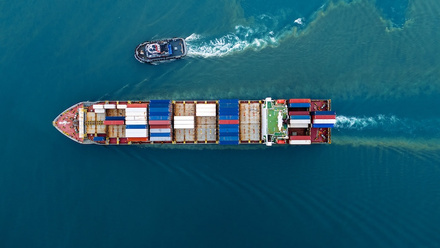
Image: cargo barge in rough sea. Credit: Shutterstock.