Inside the race to biobank marine life
As climate change transforms marine ecosystems and pressure on the ocean grows, biobanking is gaining more attention
On the west coast of Scotland, a team of people are carefully keeping thousands of algae, protozoa, and cyanobacteria alive in controlled rooms. In the USA, reproductive material from endangered sea stars has been stored in a frozen state. Over the coming years, a repository in Korea is expected to become home to biological samples collected from the deep sea.
These are just a few examples of marine biobanking – the practice of storing biological material along with information about its origin.
Biobanks are not simply vaults for marine life. They offer the possibility to study change, support restoration, develop new technologies, and give more scientists access to material they could not collect themselves.
Nature in storage
At the Scottish Association for Marine Science, the Culture Collection of Algae and Protozoa, known as CCAP, maintains more than 3,200 strains of microalgae, seaweeds, cyanobacteria, algal pathogens, and protozoa. They have been isolated from marine, freshwater, brackish, and terrestrial environments across the world. Some have come from more unexpected places, like the hair of a sloth. Many are old. Its oldest strain dates back to 1892. All of them are alive.
The CCAP can be thought of as “something between a botanic garden and the Millennium Seed Bank,” explains Dr Michal Ross, Head of the CCAP and Lecturer in Algal Biotechnology at SAMS.
To date, the strains have been used for everything from conservation and rewilding to education, water quality, biotechnology, pharmaceuticals, and aquaculture.
Across the Atlantic, the San Diego Zoo Wildlife Alliance’s Frozen Zoo biobank houses cryopreserved cells and gametes for conservation. One example of these efforts is the critically endangered sunflower sea star. In a recent collaborative effort with Birch Aquarium at Scripps Institution of Oceanography, scientists used fresh sperm, frozen sperm, and cryopreserved sperm held in SDZWA’s Frozen Zoo to fertilise eggs from a female sunflower sea star. The project has been hailed as a step towards improving future breeding efforts.
Common heritage, uncommon access
Alongside science, innovation and conservation, biobanks can also support access to samples that may otherwise be extremely difficult to obtain. This is particularly true of the deep sea which requires expensive resources like ships, sampling equipment and specific human expertise to access.
The International Seabed Authority (ISA) is responsible for mineral-related activities in “the Area” – the seabed beyond national jurisdiction. Those who want to explore and potentially exploit mineral resources in the Area are awarded contracts by the ISA.
“Our contractors have an obligation to establish an environmental baseline, so they are collecting biological samples,” explains Jose Dallo Moros, ISA’s Director of the Office of Stewardship, Environment and Resources. Contractors are recommended to store specimens in a long-term storage facility when studies are completed. These samples are dispersed across natural history museums and private repositories that may not always be accessible to the research community.
Proper curation is no small undertaking. CCAP, for example, features large fridges and incubators set to different temperatures to accommodate the different needs of its organisms. Ensuring the environment is sterile is key.
“If you've gone to pains to go to the Antarctic to isolate a polar diatom, you've purified it to get a monoculture, but it gets contaminated in some way at the final hurdle in the lab, then that is a disaster," says Ross. Meanwhile, cryopreservation and backup facilities help ensure against any potential failure such as contamination, infrastructure failing, or cultures dying.
With both sampling and curation being resource-heavy and technically demanding, access to deep-sea biological material remains limited to a privileged few. However, under the UN Convention on the Law of the Sea, the Area is the common heritage of humankind. The BBNJ agreement, the landmark High Seas Treaty that entered into force in January 2026, explicitly highlights fair and equitable sharing of benefits. Broader access to materials would also support research that underpins decisions, including those made by the ISA.
The ISA’s Deep-Sea Biobank Initiative aims to change that. A dedicated biobank, funded by the Korean government will be built at the National Marine Biodiversity Institute of Korea to house physical deep-sea specimens. For the contractors who deposit their samples, they will be relieved of the costs and logistics to maintain them. For the research community, training, opportunities for collaboration and knowledge exchange, and support for access to the samples will allow scientists from across the world to go to Korea, study samples, and build expertise.
"It's a win across the board," says Dallo Moros. "For contractors, for scientists, for countries, and for humanity."
Beyond the sample
A biological sample is only as useful as the information attached to it – what it is, where it came from, how it was collected, and under what conditions. "It's not only the coral that you bring that is very nice," says Dallo Moros. "You need all the associated things for that sample to be used."
This is harder to achieve than it might seem. Sampling techniques vary between collectors, and data recorded inconsistently can be difficult to use for scientific purposes. The ISA has assembled a group of experts from different regions and backgrounds to develop standardised sampling and storage procedures, setting a minimum standard for quality, traceability, and scientific usability.
As technology advances, so too will what will be expected of a sample and the data surrounding it. At the CCAP, work is underway to retroactively enrich decades-old records with DNA barcodes, pigment profiles, and fatty acid data from older samples.
"We've embarked on a project – Natural Products BioHUB – in which we're trying to get FTIR fingerprints [a technique that identifies the chemical composition of an organism], pigment profile, fatty acid profile to understand organisms better,” says Ross. “Marrying together these genetic datasets with chemical profiles for the entire collection is a dream and will be invaluable data for generations to come."
As climate change transforms marine ecosystems and pressure on the ocean grows, biobanks’ value will only grow. The biological material held in these collections, be it a living culture, a frozen cell, a specimen retrieved from the deep-sea floor, may yet prove invaluable.
Tell us what you think about this article by joining the discussion on IMarEST Connect.
Image: Sunflower sea star. Credit: Shutterstock
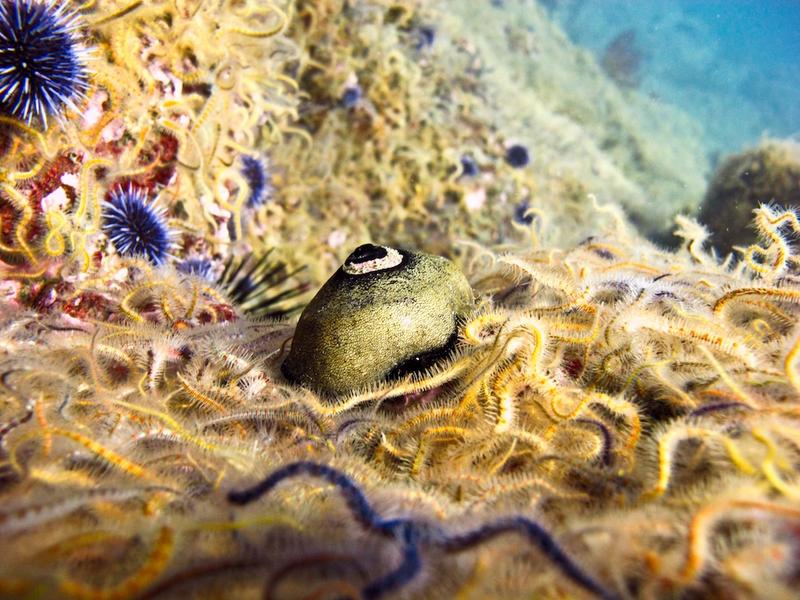
Inline image: A nudibrach crawls over brittle sea stars. Credit: Shutterstock