The Seven Cs and Three Ss shaping the future ship
With the INEC/iSCSS conference just weeks away, we look at the forces reshaping naval engineering and ship control systems – from autonomy, AI and cybersecurity to energy transition, resilience and the changing role of the crew.
Big themes are on the agenda at the upcoming International Naval Engineering Conference and Exhibition, incorporating the International Ship Control Systems Symposium. The event promises to keep attendees up to date with the latest trends and developments in the naval engineering and ship control systems sector.
According to iSCSS Vice Chair and Associate Professor at the University of Genoa, Michele Martelli, several converging challenges are impacting this sector: autonomy, cybersecurity, digitalisation, energy transition, system integration and human-machine collaboration.
Those challenges are reflected in the two themes chosen for this year's INEC/iSCSS conference. INEC will examine the “Seven Cs” – Competition, Collaboration, Capability, Compliance, Connectedness, Crewing and Climate – while iSCSS will focus on three defining characteristics of future ship control: Secure, Smart and Sustainable.
“The increasing use of automation and autonomous functions is one of the most significant developments,” says Professor Martelli. “Ships are becoming more dependent on advanced control systems, decision-support tools, sensor fusion, remote supervision and, in some cases, reduced levels of human oversight. This creates important technical and regulatory questions around safety and reliability, and on the role of the human operator.”
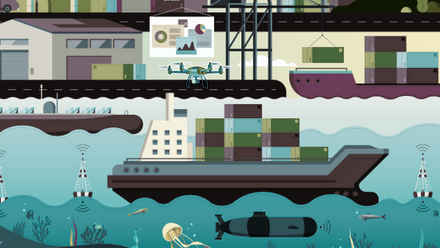
Cybersecurity is another crucial priority. “Nowadays ships are no longer isolated platforms; they are, and will be even more, highly connected systems,” says Professor Martelli. “Navigation, propulsion, power management, communications and monitoring systems increasingly depend on digital networks and software-based architectures. As a result, cyber resilience must be treated as a core engineering requirement rather than as an additional layer added after design.”
A further key issue is the integration of complex power and energy systems. Hybrid propulsion, DC grids, energy storage, power electronics, alternative fuels and advanced energy-management systems all require more sophisticated control strategies. “These systems must be efficient, reliable and resilient, particularly in naval and safety-critical applications where continuity of power and mission availability are essential.”
Finally, the sector is increasingly focused on artificial intelligence, digital twins, explainable automation, data fusion and human-machine interfaces. “These technologies offer major opportunities, but they also introduce new concerns around trust and through-life support,” notes Martelli. “The main challenge is therefore, not simply to make ships more digital or more autonomous, but to ensure that future ship control systems remain safe, secure, sustainable and operationally dependable.”
The seven Cs
Competition looks at how to maximise the utility of small and medium enterprises juxtaposed with the role of Primes while collaboration covers changes in naval/government procurement models including joint programmes; and how navies and governments can work more closely with industry, especially more agile companies in leveraging innovation.
Capability assesses how we can maximise spiral development and future proof design, explains Neil McCallum, INEC Chairman and Senior Naval Advisor, National Armaments International at the Ministry of Defence.
It also considers how to “harness the speed of technological evolution, use alternates solutions to develop mass and challenge whether the capability should be exquisite or disposable,” adds McCallum, who says that aligned to this is resilience. “We need to ensure availability and reliability, but to do so there is the necessity to consider enabling auxiliaries in the same manner as the high-end systems they support and give them the same attention.”
Next up is compliance: “The maintenance of compliance without compromising capability can be a greater challenge for the naval community than the commercial one, but also one where the development and adoption of new technology needs faster development of regulation so that ships and system are safe to operate and can be operated safely.”
For connectedness, McCallum explains that hybrid navies and the adoption of unmanned systems and autonomous units is a system of systems approach requiring greater integration, communication and control mechanisms which need to be resilient and secure. “But also, how we need to maximise the use of digitalisation including software upgrades, twins and remote diagnostic tools to increase efficiency and operational effectiveness be that in build or in service.”
Crewing is all about how to balance the role of human and computer whilst striving for minimum crew sizes - yet considering the differing functions that may be asked of a crew in peace and conflict. “Where to place the crews for remote operation of platforms, and to consider the requirement and location for the maintenance crews of the off-board systems, especially if larger and more complex,” says McCallum. “But also, how do we train and retain the people, and skill sets we need now and into the future.”
The final C is climate: “We need to ensure we retain global access, but how to overcome the challenges posed for naval ships including how to fuel the power and meet the legislation around our impact on the environment in which we operate.”
Secure, smart and sustainable
Meanwhile, iSCSS will be focusing on “Future-Proofing Secure, Smart and Sustainable Ship Control”.
“The word “secure” is central because ship control systems now operate in a highly-connected environment,” explains Professor Martelli. “Cybersecurity has become one of the most important topics even in the maritime domain, since a cyber incident affecting control, propulsion, navigation, or power management systems could have direct and severe consequences. Security must therefore be embedded in the design, integration and operation of the future ship control systems.”
“Smart” refers to the adoption of AI-related technologies, advanced automation, digital twins, decision-support systems, data fusion and autonomous navigation. Martelli observes that these technologies are becoming pervasive, but their implementation must be accompanied by rigorous validation and, currently, by an appropriate human oversight. “A smart system must not only be technically advanced; it must also be trustworthy, predictable and usable in critical operational conditions. For the latter point, it is important that the international regulatory frameworks keep pace with technological advancements.”
The term “sustainable”, instead, reflects the environmental dimension of future ship control. “Advanced control systems will be essential for improving energy efficiency, managing hybrid power systems, supporting alternative fuels and reducing the environmental impact of maritime operations. In this sense, the theme brings together three priorities that can no longer be treated separately: technological innovation, cyber and operational resilience, and environmental responsibility.”
Book your tickets now for INEC/iSCSS, which takes place on 10-12 November 2026 at the John McIntyre Conference Centre, University of Edinburgh.
Tell us what you think about this article by joining the discussion on IMarEST Connect.
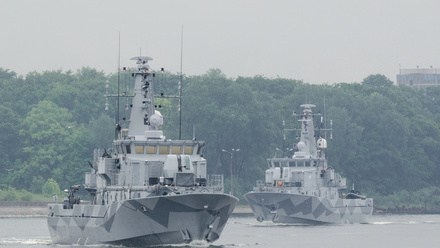
Main image: An Italian Navy Orizzonte class air defence destroyer leaves Portsmouth naval base, 2022. Credit: Kevin Shipp/Shutterstock.