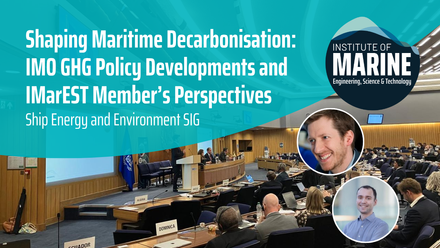
Towards agreement: what ISWG-GHG 22 means for the Net-Zero Framework
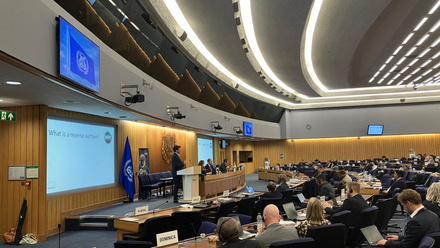
In the first week of September more than 1200 delegates of the International Maritime Organization (IMO) came together as the Intersessional Working Group on Reduction of GHG Emissions from Ships (ISWG-GHG 22). Their task was to address concerns surrounding the IMO’s draft Net-Zero Framework and ensure any amendments remain aligned with the targets set out in the 2023 Greenhouse Gas Strategy.
Alasdair Wishart, our director of technical and policy, shares his insights from the week.
Before looking at the detail of the negotiations, it is worth considering what failure would mean. Without a clear and globally agreed framework, the maritime sector faces the prospect of an increasingly fragmented regulatory landscape, with national and regional schemes emerging to fill the vacuum. We are already seeing signs of this.
From an engineering, science and technology perspective, a lack of regulatory certainty also delays investment decisions, slows innovation, complicates workforce development, and reduces confidence in the technologies needed to support shipping's transition. And all these factors increase costs, hampering the development of a financially sustainable industry that will thrive in the future.
Led by Professor Tristan Smith FIMarEST of University College London (UCL), the IMarEST's IMO delegation for greenhouse gases draws its expertise from across industry and academia. Our role is to use the Institute's collective expertise to provide independent, technical advice to help delegates understand how different policy designs might work in practice.
Having followed the discussions closely as a member of the delegation, I came away with a strong belief that the conversation has moved on significantly since the suspension of the NZF adoption process in 2025. Important disagreements remain, but the debate is increasingly about how the framework should be refined, rather than whether it should exist at all. There appeared to be little appetite to abandon the NZF altogether.
New options on the table
The central question facing delegates was whether the NZF agreed in principle in 2025 should continue to form the basis of future work. Six alternative proposals from various member states were under discussion, but none appeared capable of attracting sufficient support to replace the framework outright. Instead, discussions focused on how elements of those proposals might be incorporated into a final collective package.
Ahead of ISWG-GHG 22, the IMarEST delegation submitted analysis designed to help member states assess the potential effects of four of the policy options under consideration (the proposals from Japan and the UAE were not yet available and could not be analysed). This was the first study to model the specifics of the four proposals side-by-side, building on the assumptions and methodology used in the IMO's own Comprehensive Impact Assessment of mid-term measures.
The study built on the IMO-commissioned comprehensive impact assessment modelling methodologies to evaluate the economic, social, environmental and trade impacts of the IMO's proposed mid-term GHG reduction measures,
The IMarEST work evaluated each option against the IMO’s 2023 GHG Strategic Objectives; emissions reductions; potential for a just and equitable transition; and technology which can enable shipping's energy transition. It also examined trade-offs between environmental performance, cost impacts.
A key finding from the work was that the ‘levy-based’ framework is most likely to deliver the IMO's 2030 and 2040 emissions reduction checkpoints. This option proposed using fixed financial penalties for vessels not complying with emissions standards, and only subsidising operators using zero, or near zero, fuels and technologies.
However, the analysis also highlights that keeping the Net-Zero framework in its current form, could offer the lowest average carbon abatement cost among the pricing-based options, provided significant increases in biofuel prices are avoided before 2038.
The analysis used the most up-to-date modelling undertaken UCL’s Energy Institute Shipping and Oceans Research Group and the Rocky Mountain Institute.
Softer start, harder finish?
One of the most active areas of debate concerned the trajectory for reducing greenhouse gas fuel intensity (GFI).
Several member states argued for a softer start to the framework, reducing compliance pressure in the early years after implementation, with many supporting the idea of a less demanding pathway initially, offset by steeper reductions later in the 2030s. The rationale was familiar, with concerns over fuel availability, affordability and the pace at which infrastructure can be developed.
Others warned that weakening early signals risks delaying investment and prolonging dependence on transitional fuels. However, there was a broad acceptance that the overall destination has not changed, and the discussion was largely about timing rather than ambition.
A related debate centred on the importance of retaining a clear 2040 target. This was one of the areas where industry observers were especially vocal. Throughout the week, it was clear that predictability matters. Investors considering alternative fuel production facilities, bunkering infrastructure, or new vessel technologies need confidence about the direction of travel.
Funding the future
Another major theme was the future of the IMO Net-Zero Fund and the wider economic architecture of the framework. This has long been a disputed area and continued to be contentious at ISWG-GHG 22, although UCL's analysis after the event suggests that around two thirds of delegates were in support.
A minority of delegations continued to oppose the concept of a fund and questioned the appropriateness of a mandatory emissions-pricing mechanism within MARPOL.
Supporters argued that a centralised fund or facility remains essential to connect regulatory obligations with real-world decarbonisation outcomes. Revenue generated by the framework is intended to support the uptake of zero and near-zero (ZNZ) fuels and contribute to a just and equitable transition for developing states.
Nevertheless, the balance of interventions suggested continued support for retaining some form of economic measure alongside emission-reduction targets. From an industry perspective, that is important because it reflects a continued recognition that emission targets alone are unlikely to drive investment at the scale and pace required.
The meeting also revisited how ships would comply with the framework. Debate around direct project contributions received a mixed reception. Concerns were repeatedly raised regarding governance, transparency and the integrity of incentives.
While these ideas remain under discussion, there appeared to be stronger support for building on the existing NZF structure rather than replacing it with an entirely different policy design. Discussions around support for ZNZ fuels generated a similar outcome.
While member states differed on the precise method of incentivisation, there was broad agreement that some form of targeted support remains necessary. Whether through the existing version of reward mechanism, compliance multipliers or another approach, many delegates recognised that emissions targets on their own are unlikely to stimulate sufficient early investment in scalable zero-emission fuel pathways.
What's next for the NZF?
Things will certainly be hotting up at the IMO over the next few months. Delegates will meet again at the next intersessional working group towards the end of November, where a draft Net-Zero Framework is expected to be put before delegates. An agreed version will then go forward for adoption at MEPC 85 the following week.
It's hard to predict the future, but looking back at ISWG GHG 22, important questions remain unresolved. However, the conversation is increasingly focussed on finalising the package which, for an industry seeking certainty, may be the most important thing of all.
This article was first published on the Ship.Energy website.