Fins for forecasts: why your next research partner could be a shark
Recent research found that adding data collected by tagged sharks could improve seasonal ocean forecasts by up to 40%
Reliable ocean forecasts underpin decisions across the maritime sector. Shipping routes, fisheries management, offshore operations, and search and rescue all depend on knowing what the ocean is doing now, and what it is likely to do next.
Behind these forecasts is a swathe of data. Satellites provide broad coverage of the ocean surface, while in-situ instruments such as gliders, floats and buoys can collect measurements below it. But observations remain limited, especially in dynamic areas such as fronts, eddies and upwelling zones, where measurements are difficult to obtain and conditions can change quickly. In a recently published study, Dr Laura McDonnell, a postdoctoral researcher at Woods Hole Oceanographic Institution, found one solution to this data shortage – and it comes with fins.
Better forecasts from animal-borne data
While some marine species stay local, others travel vast distances. Among them are blue and shortfin mako sharks. In the Northwest Atlantic Ocean, “[they] spend a lot of time along the shelf and the Slope Sea... they [also] target long-lived, big, retentive, warm core rings,” explains McDonnell. “They're targeting those features and those dynamic areas that are hard to measure.”
In October 2021, while McDonnell was doing her PhD at the University of Miami, she and her colleagues attached tags to the dorsal fins of 18 blue sharks and one shortfin mako off the coast of Cape Cod. For the next six months, these sharks swam through the Northwest Atlantic and down to depths of nearly 2,000 metres. When their fins broke the surface, the tags communicated with satellites, sending some 8,200 temperature and depth profiles to the researchers.
To test whether those observations could improve forecasts, the researchers added them to a seasonal ocean model – a tool used to predict conditions over weeks to months. McDonnell and her collaborators weren’t necessarily expecting to see much of an impact, but the results were a pleasant surprise.
Adding the shark data improved forecasts by up to 40% in dynamic areas, like the continental shelf and the Slope Sea. Other parts of the ocean also benefited, though not as much. Forecasts for the Sargasso Sea, for example, didn’t see as much of an improvement. McDonnell says that the differences may simply reflect where the tagged sharks spent most of their time. “I think if we had gone out to the Sargasso Sea, and tagged 20 of them there, it's possible we would have seen more improvements in that region as well.”
Casting a wider net
The study, published in npj Climate and Atmospheric Science, is the first to explore how data collected from tagged marine animals could improve seasonal models. McDonnell hopes it won’t be the last. Her paper has already drawn interest in the research community. Discussions include testing the data in a higher-resolution regional model that can better capture the details of dynamic features in the northwest Atlantic to see if those models also perform better.
“Another is adding more sensors. Variables like conductivity, oxygen, and measuring all of that at depth,” McDonnell says.
Data doesn’t have to be limited to new research either. McDonnell points out that many marine animals have already and are still being tagged with sensors that collect oceanographic data for ecological research. “All of that data is sitting in repositories, and a lot of it has at least temperature and depth associated with it.” If shared, that data could help improve models. “We're kind of at a critical point, right. The ocean's in trouble. So why not squeeze as much value as we can out of existing data and also [from] future efforts,” she says.
With the maritime sector and coastal communities increasingly relying on accurate ocean information, any improvements to model forecasts can only be a good thing. Perhaps that next improvement will come courtesy of a shark.
Interested in this subject? Why not join our Marine Mammal SIG? New members always welcome.
Tell us what you think about this article by joining the discussion on IMarEST Connect.
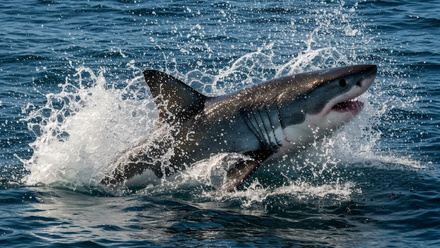
Image: Blue shark, near Cape Cod. Credit: Ethan Daniels/Shutterstock