Floating Offshore Wind: what lies beneath
A planned increase in floating offshore wind means increased subsea infrastructure – but what will this mean for the marine environment?
Floating offshore wind (FOW) enables large-scale wind energy deployment in deep waters (typically more than 60 metres), where fixed-bottom foundations are not feasible. Unlike conventional offshore wind, floating systems rely heavily on subsea infrastructure - particularly moorings, anchors, and dynamic electrical cables - to maintain station and transfer power. These components interact directly with the marine environment, creating both challenges and opportunities for environmentally responsible design.
The subsea components
Floating wind turbines are held in position using mooring lines connected to seabed anchors. Common anchor types include drag anchors, suction buckets, driven piles, and gravity-based anchors, with the selection dependent on water depth, soil conditions, turbine motions and cost considerations.
While derived from oil and gas practices, the scale of FOW farms means a much higher density of anchors and moorings, raising new environmental questions around seabed footprint and cumulative impacts.
Unlike fixed-bottom wind, floating turbines require dynamic array and export cables that move with wave and current motion. These cables may be suspended through the water column before reaching the seabed, making them more exposed to fatigue, abrasion, and marine interactions.
Dynamic cables also emit electromagnetic fields (EMFs) not confined to the seabed, which differentiates floating wind from traditional offshore wind from an environmental standpoint.
Seabed disturbance and habitat alteration
Anchor installation and cable laying disturb seabed sediments, potentially affecting benthic habitats and infaunal species. Although the disturbed area of each anchor is relatively small, the cumulative footprint across large floating wind farms can be significant.
However, there is also evidence that anchors and mooring components may act as artificial reefs, increasing local biodiversity and biomass by providing hard substrate in sediment-dominated environments.
Underwater noise
Noise is generated primarily during installation phases (anchor drilling, pile driving, cable trenching). This noise can temporarily disturb fish, marine mammals, and invertebrates, potentially causing avoidance behaviour or stress responses. Operational noise from moorings and cables is generally low compared with installation impacts.
Electromagnetic Fields (EMFs)
Subsea power cables generate EMFs that can be detected by electro- and magneto-sensitive species such as sharks, rays, some fish, and sea turtles. For floating wind, the presence of dynamic cables in the water column introduces potential exposure of pelagic species, an impact pathway largely absent in fixed-bottom wind farms.
Current scientific consensus indicates that EMFs from offshore wind cables are unlikely to cause population-level impacts, but data for floating wind configurations remain limited, and uncertainty persists.
Entanglement and barrier effects
Mooring lines may pose an entanglement risk to large marine species such as whales, particularly in regions with high marine mammal density. Additionally, arrays of moorings could act as partial movement barriers for some species, though empirical evidence is currently sparse.
Mitigation and sustainable design approaches
Research initiatives increasingly focus on sustainable-by-design anchors, aiming to reduce seabed footprint, installation disturbance, and material use while maintaining safety and performance. Suction bucket and shared-anchor systems are examples of approaches that may reduce cumulative impacts.
Careful routing of cables to avoid sensitive habitats, combined with selective burial or protective measures, can significantly reduce ecological disturbance. For dynamic cables, design improvements that limit seabed contact and fatigue also reduce the need for heavy protection structures.
Given the limited operational history of large floating wind farms, adaptive management - using monitoring data to refine mitigation measures over time - is widely recommended by regulators and researchers.
Overall environmental balance
Despite localized impacts, multiple studies conclude that floating offshore wind, including its subsea infrastructure, poses manageable environmental risks when best-practice design and mitigation are applied. Compared with fossil fuel alternatives, lifecycle assessments consistently show offshore wind to have substantially lower overall environmental and climate impacts.
As floating wind projects scale up globally, continued research, monitoring, and sustainable engineering will be crucial to ensuring that environmental impacts remain low while supporting the transition to low‑carbon energy.
Tell us what you think about this article by joining the discussion on IMarEST Connect.
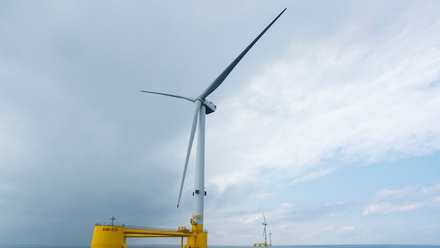
Image: The Provence Grand Large floating wind farm. Credit: Shutterstock.