IMO Net Zero Framework back on the table
The outcome of the IMO’s latest discussions could shape the pace of shipping’s decarbonisation, with competing proposals raising questions over emissions targets, investment incentives and the future of the Net-Zero Fund.
A year after adoption was postponed, the IMO’s Net-Zero Framework is back on the table at the upcoming Marine Environment Protection Committee (MEPC 85).
Approved in principle in April 2025, the Framework aims to reduce greenhouse gas emissions from international shipping, but what it will entail remains uncertain.
“At the moment a broad range of options are on the table, both in terms of policy architecture and in terms of ambition/specification,” says Dr Tristan Smith (FIMarEST), Professor of Energy and Transport at University College London and member of the IMarEST’s delegation to the IMO. The final agreement could range from an ambitious framework to one offering little incentive for emissions reductions, or even a further postponement.
Questions around fuel intensity requirements
Some discussions have focused on the framework's fuel-intensity requirements (GFI), which set progressively stricter limits on greenhouse gas emissions. Proposals include relaxing the initial base target before introducing steeper reductions later.
If any relaxation does occur, Smith says that it is important that it is only slight, otherwise the effect could be that less favourable fuels see a longer period of competitiveness and reduce the price of credits used to trade compliance. “This would reduce incentive to invest in / operate on lower carbon (e.g. biofuels) and more scalable solutions (e.g. e-fuels),” he explains.
“However, if the relaxation is only slight, and the increase in stringency over time is certain, and there’s a strong reward mechanism, then some use of a range of fuel options in parallel is possible,” he says.
Net-Zero Fund remains contentious
Central to the Framework is the Net-Zero Fund – a mechanism for collecting revenues from vessels exceeding emissions thresholds to support cleaner fuels and other decarbonisation objectives.
Smith says that member states have different concerns, including the IMO collecting and controlling significant levels of revenue, the institutional and administrative feasibility of the proposal, whether the fund will have enough revenue to cover all the objectives, and a lack of clarity over where the fund revenues will go.
Some proposals would remove the Fund altogether, something Smith warns could erode compliance incentives and investment in cleaner fuels.
“Having a ‘third compliance’ option of paying into a fund for a fee which is a higher cost than compliant fuel use creates a compliance incentive whilst also retaining flexibility,” he explains.
“An effective reward mechanism focused on zero- and near-zero-emission fuels can help bring investment and operation/use into the long-term solutions forwards to happen in parallel with use of short-term non-scalable fuel options.”
Uncertainty for the industry
Smith says further delays in adopting the Framework could impact confidence in the IMO's ability to reach a timely agreement and risks individual countries or regions developing their own regulatory mechanisms.
However, the greatest risk of postponement, Smith says, is that it “could dramatically undermine those who have decarbonisation products/solutions and have invested in preparation for regulation, and/or those shipowners who prepared in good faith that effective regulation would be adopted.”
However, Smith says postponement isn’t the only source of uncertainty. A low-ambition agreement could also create uncertainty as it would likely require strengthening in the future.
“This ecosystem of first movers and solution providers needs to be healthy and if it is badly damaged by continued uncertainty, it may not be in a good state when ultimately is needed.”
Nevertheless, Smith believes an agreement is likely even if the outcome is difficult to predict. At the Intersessional Working Group on Reduction of Greenhouse Gas Emissions from Ships (ISWG-GHG 22) held in September, Smith says that “there was a clear sense that member states wanted to resolve and clarify as much of the detail as possible at MEPC 85.”
“The fact that a range of options are there is positive and means that the case for high ambition needs to keep being made in the hope that this can be adopted and the industry can confidently set a clear direction forward.”
Tell us what you think about this article by joining the discussion on IMarEST Connect.
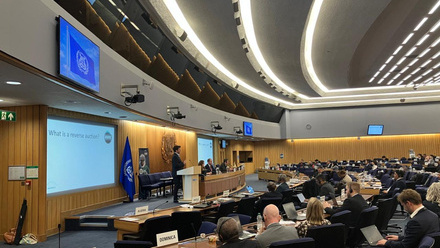
Main image: IMO Building in London
Credit: William Barton/Shutterstock