Robotic sailboat makes Atlantic crossing history
After 16 years of failed attempts, a British-built robotic sailboat has become the first to cross the Atlantic entirely autonomously, marking a milestone for unmanned maritime technology.
For 16 years, small robotic boats have set out to cross the Atlantic on the Microtransat Challenge, only to succumb to storms, mechanical failures, software glitches or fishing nets. Some simply vanished without a trace. Then in September 2026, a small robotic sailboat became the first to complete the journey entirely autonomously.
Built by British maritime technology company Oshen, C-Star PC13 reached the finish line east of Barbados on 13 September, after travelling nearly 5,000 kilometres from the Canary Islands over 127 days.
Established by Dr. Mark Neal of Aberystwyth University and Dr. Yves Briere of the Institut Supérieur de l’Aéronautique et de l’Espace, the Challenge aims to “stimulate the development of autonomous boats through friendly competition.”
Open to anyone, the Challenge is held annually. It allows both fully autonomous vessels and unmanned boats that can receive remote instructions, with separate routes and classes for sailing and non-sailing vessels. In 2018, Norwegian company Sailbuoy completed the first unmanned crossing with the aid of waypoints sent to the vessel, but Oshen is the first to succeed entirely autonomously.
A deceptively difficult challenge
"Making something that is reliable enough and can stand up to what the Atlantic will throw at it is a difficult task and one that needs a range of skills including naval architecture, mechanical engineering, electrical engineering, software engineering and even some sailing experience," says Colin Sauze, organiser of the Microtransat Challenge.
Anahita Laverack, CEO and co-founder of Oshen, explains that the difficulty lies in overcoming several competing constraints at once.
“Less than 2.5m in size is effectively a power constraint as it limits the size of your solar panels which power your control system. Wind for propulsion makes the control system trickier. Fully autonomous means it needs to sail pretty [precisely] over 100 days without any course correction, and a finish line 25km wide means again relatively precise navigation after sailing 3,500+ km.”
Then there are the conditions of the Atlantic Ocean itself. After more than 100 days at sea, PC13 encountered the developing weather system associated with Tropical Storm Dolly.
"We were concerned to see tropical storm Dolly pass over [C-Star PC13], but it handled it just fine,” says Laverack.
A demonstration of capability
The technology behind autonomous sailboats has evolved over the past 16 years, with improvements in batteries and solar panels helping considerably. “This allows bigger power budget and/or smaller boats,” says Sauze, adding that components have also become cheaper and more accessible.
The move away from fabric sails to wing sails has also been a factor. Although teams experimented with them from the beginning of the challenge, Sauze says significant engineering difficulties initially limited their use, particularly the power demands of actively controlled sails and the reliability of passively controlled designs.
Certainly, the Microtransat has demonstrated that autonomous sailboats can now make long and hazardous journeys. Both Sauze and Laverack also point to an Oshen C-Star that successfully sailed through a Category 5 hurricane in 2025 as further evidence of their capabilities.
Sauze believes such achievements demonstrate that autonomous sailing robots are "now becoming viable platforms for performing ocean science".
For Laverack, the competition has also resulted in valuable information, including data on the vessel’s velocity in different sea states, headings, and wind strength, as well as opportunities to assess sensor drift and biofouling rates.
Meanwhile, the Microtransat Challenge continues. The autonomous eastbound crossing and non-sailing classes remain unconquered, and there is always the opportunity to beat existing records.
“The Challenge is a race so there's always scope to do it faster than it has been done before,” says Sauze. “I would also love to see it done by cheaper boats from an amateur or student team.”
Tell us what you think about this article by joining the discussion on IMarEST Connect.
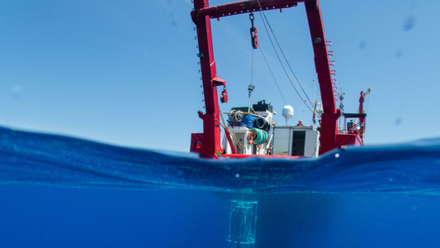
Main Image: One of Oshen’s robotic boats in action
Credit: Oshen