The future of the TLP? One platform, multiple offshore renewables
Triceratops, a platform design to solve issues confronting the ultra-deep water oil and gas industry, also shows promise as a novel solution to help harvest diverse sustainable energy sources offshore
Tension-Leg Platforms (TLPs) have been used by the oil industry to provide stable platforms in deep waters for over 40 years. To hold a TLP in place, vertical tendons are attached at extremities of a TLP’s hull and pretensioned by de-ballasting enough to restrict horizontal offsets.
The principles for design of TLPs and their water depth limitations are well understood. When water depth exceeds ~1400m, the challenges of providing adequate pretension to limit horizontal offset and vertical stiffness to avoid unacceptable resonant responses create such parasitic burdens that the TLP concept becomes impractical (except in special circumstances). Partially buoyant tendons have been designed to minimise the impact on hull buoyancy requirements, but, at great depths, the amount of high-strength steel needed to avoid resonant response in waves makes tendons extremely costly.
Spar platforms were introduced in 1990s to avoid the water depth sensitivity of TLPs. Then, to minimise the buoyancy burden of dry tree risers tying oil wells back to the spar deck (and, thus, hull), engineers distributed buoyancy along the upper section of the tieback risers within the spar’s central moonpool to create self-standing risers (SSRs). The buoyant section provides enough vertical force to support the riser and its “tree” (and related kit) sitting on top.
Each SSR is effectively a Tethered Buoyant Tower with its payload being its dry tree.
Going a step further, Edward Horton, the inventor of the very successful Cell Spar (US 6,817,309 B2) and Shell USA’s Marshall (US 4,621,949), proposed Tethered Buoyant Platform (TBP) variants as alternatives to spread-moored spars. Several offshore industry leaders (such as J. Halkyard, R. Copple, C. Capanoglu) offered their own Tensioned Buoyant Tower (TBT) concepts.
It is obvious that TLP tendons become very costly in ultra-deep waters, but the rigid “nodes” of the hull (the structural intersection of platform’s columns with the deck and the submerged pontoons) are very costly at all water depths.
One of the “tricks” for minimising fatigue in the tendons is to balance the vertical inertial forces acting on the pontoons against the buoyant forces acting on the columns over a key range of wave periods encountered in common sea states. Unfortunately, force cancellation does not work well enough in the highest seas. As a result, even though the engineers may have limited fatigue in most sea states, the tendons experience very high tensions in extreme waves.
How to radically reduce vertical wave forces
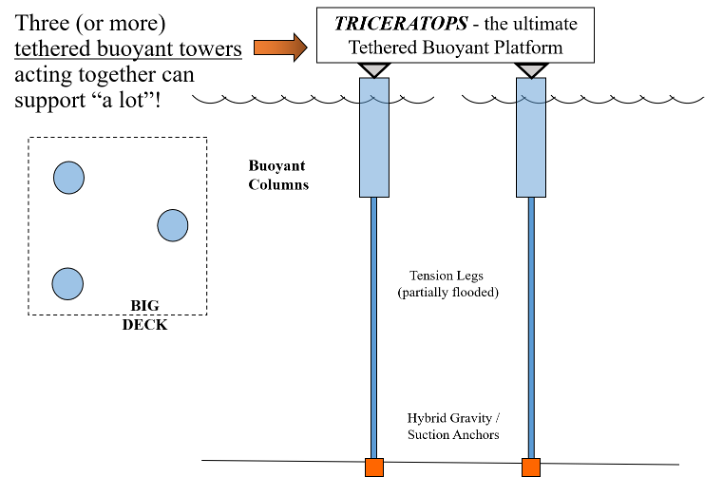
We can do this by first eliminating the pontoons and turn three (3) free-standing tendons into full TBTs by extending a large diameter buoyant section up out well above the sea surface while pushing its bottom down about 100m below (even deeper in the harshest environments).
As with spars, the facilities deck of a big TBP must be lifted into place after the hull has been installed. This aspect tends to limit the size and weight of the deck that can be placed on top (or force multiple heavy lifts). Further, while TBPs require much less hull steel than spars, spars provide conveniently located central moonpools for drilling and riser operations.
Introducing Triceratops
The elegant and sturdy Triceratops platform concept (Fig. 1) has its deck and facilities held well above the waves. There are many viable options for the articulating connections between the column tops and the deck structure – straightforward adaptations of existing engineered solutions
Though intended initially for “permanent” oil & gas facilities in very deep water, the Triceratops concept can serve many purposes and industries across many water depths – including an efficient foundation for “harvesting” multiple renewable energy sources simultaneously in moderate to deep waters offshore.
Fig. 1 – Creating a Triceratops platform
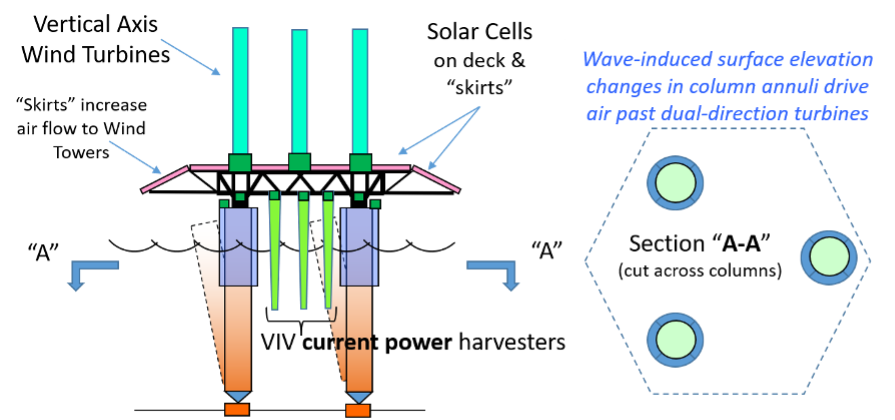
To make offshore harvesting of renewable power economically practical, it is necessary to limit the number of offshore platforms needed to support grid-scale offshore power generation. A “Tower of Power” that aggregates a variety of energy harvesting devices on each platform to limit intermittency of supply can do this (Fig 2):
- WIND - multiple Vertical Axis Wind Energy Extractors on deck (instead of bird and whale harming turbines);
- WAVE - Bi-direction air turbines drive generators on top of each leg (or via ducting very high up above the main deck and sea spray) and…
- Generators at the joint between articulating legs and stable deck structure;
- CURRENT - using tunable vortex-induced vibration (VIV) energy harvesters to capture kinetic energy on deck, avoiding submerged turbines
- SOLAR - Solar power collectors arranged on/around large deck and even…
- OTEC (Ocean Thermal Energy Conversion)… and/or
- GEOTHERMAL
If the Tower of Power is located far from grid, hydrogen can be generated and converted to NH3 (ammonia) on deck and stored in the columns for export by boat or pipeline. Alternatively, container-sized batteries can be used for shipping stored e-power to regional markets.
Depending on seafloor conditions, concrete columns can land on pre-installed footings… or have bottom-piercing pile extensions that secure its location in waters of moderate depth.
Fig. 2 - Triceratops “Tower of Power” concept at moderate water depth
Evolutionary studies continue
Triceratops (the foundation for a true Tower of Power) is so elegant that many researchers in India have completed key foundational studies (ref. Chandrasekaram & Seeram IJIR&D, Dec’12 through N. Raichandran, JMSD Oct’24). Model tests on spread-moored platforms with decks supported by deep columns having articulated joints at their deck connections initiated in France (for FINA) in the 1980s and extended through the work of Jon E. Khachaturian with industry leader, Versabar, well into the 21st century.
Reliability of supply is as important as the theoretical peak power deliverability of sustainable energy harvesting systems offshore. This concept allows inclusion of many different types of harvesters on every platform to achieve high and reliable power delivery to limit the number of offshore installations and subsea wiring interconnections needed, while eliminating spread moorings and much seafloor clutter. All the critical electrical equipment can be located for convenient access well above the sea surface to limit exposure to saltwater and simplify maintenance.
Tell us what you think about this article by joining the discussion on IMarEST Connect.
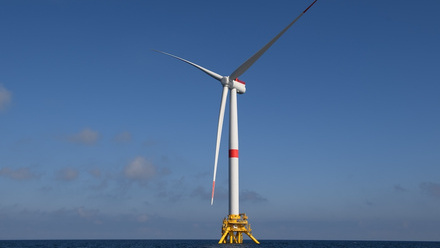
Image: Offshore wind turbine under construction. Credit: Shutterstock