Crewman crushed on mv Laureline
When a crewman was crushed on a ro-ro vessel, it again highlighted lessons are still to be learned
The fatal accident happened on mv Laureline (IMO9823352) while the ship was in port at Purfleet, England on 13 July 2024. Such incidents are too common: three years before the Laureline fatality, there was a markedly similar occurrence on the mv Clipper Pennant, also in the UK, while this summer there was another crush fatality on the mv Delphine in Zeebrugge.
What happened
At 1435 on 13 July, specialised cargo repositioning tractor units began to offload the cargo trailers from the four vehicle decks of Malta-flagged ro-ro vessel Laureline. These terminal tractor ‘tug’ units, designed specifically for manoeuvring trailers in tight spaces, allow the driver to swivel 180° to face the trailer.
The vessel’s first officer was in the cargo control room, the second officer was working on the bridge and a quartermaster stood by the cargo ramp, monitoring the traffic. The bosun was stationed on the main deck.
By 1650, two able seamen were beginning cargo loading operations. Though most of the trailers set to be discharged at Purfleet had been offloaded, the final trailer was blocked by ‘Trailer A’. Trailer A would need to be moved for operations to continue. On the starboard side, able seaman ‘AB2’ removed the lashings from the final trailer, allowing it to be disembarked from the ship. AB2 then stood on the port side of Trailer A and marshalled it into position on the deck’s starboard side. The noise of the ventilation fans partially obscured the sound of their voices.
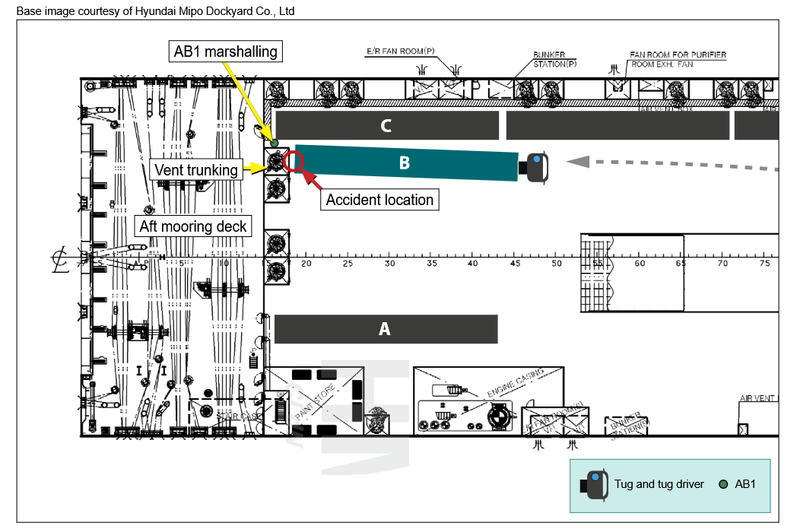
At the same time, able seaman ‘AB1’ was marshalling a second trailer, ‘Trailer B’ into place, positioning himself between a parked trailer (‘Trailer C’) and the bulkhead at the aftmost part of the deck. The driver positioning Trailer B moved forward slightly to straighten up, before reversing again and stopping.
A reconstruction of trailer positions at the accident scene later indicated that the person driving the tug would have needed to lean their head out of the window to see a person standing between Trailer C and Trailer B. The front of Trailer B was several feet in front of Trailer C. The driver could not, from his position, have seen the vent trunking box which protruded around a metre from the wall.
It was at this moment, assuming the manoeuvre was completed, that AB1 made his way behind Trailer B, presumably with the intention of emerging in the middle of the deck, ready for the next trailer. But he was unaware of the driver’s intentions. After a five-second pause, the driver reversed again, crushing AB1 against the vent trunking.
AB2, who had been undertaking lashing on the starboard side of trailer A and whose view had been obscured, now ran out and waved his arms at the driver in the cab. Crew rushed to provide first aid to AB1, who had suffered severe crushing injuries to the head and thorax. But a short time later at 1735, as ambulances arrived, AB1 was declared dead by paramedics.
Findings
Scratched paintwork on the vent trunking, and damage to the vehicle’s rear bumper, indicated that Trailer B had backed all the way into the trunking. Investigators noted that from the driver’s cab, the view of the vent trunking structure was entirely occluded by the trailer. Neither Trailer A, across the deck, nor Trailer C, the parked trailer which neighboured Trailer B, had vent trunking behind them.
This meant that the driver’s visual reference would suggest that his trailer was improperly positioned, something that he might have determined during the five-second pause in his reversing manoeuvre. In the time-pressured working environment, this pause had been long enough for AB1 to assume that the driver’s manoeuvres were complete, and that he was safe to walk behind the trailer – a decision that ultimately claimed his life.
Investigators determined that the level of noise from both the ventilation and the tug engines could have obscured the sound of AB1’s ‘stop’ whistle, making it unreliable and difficult for the driver to rely upon. As well, the gap between Trailer B and Trailer C was just 20cm. Though it may have been possible for AB1 to traverse the gap along the trailer’s left side and around the front of the cab to attend lashing duties on the right side, while maintaining line-of-sight between himself and the driver, the comparative shortcut around the back of trailer B – which he had considered to be parked – might have seemed more pragmatic.
Procedure dictated that two crew members were on the deck specifically to monitor one another. In theory, that procedure encouraged two ABs, acting as marshallers, to work on the same trailer (though as MAIB determined, this was not ‘explicitly stated’ in the relevant guidelines). In practice, the crew determined that this meant they could use their time twice as productively by marshalling two trailers into place at once. That decision put AB2 on the far side of Trailer A from his colleague, undertaking lashing, which meant he could not have observed what unfolded. (It is unclear, however, that his intervention could have stopped what transpired, either by divining the driver’s intention to continue reversing, or his colleague’s decision to pass behind Trailer B).
The pivotal issue, in fact, was that of communication, according to the MAIB report. The driver, AB1 and AB2 were “working independently”, with no inkling of one another’s intentions. According to the report, “the interaction between the tug driver and AB1 was based on assumptions instead of positive feedback, with the result that neither had a clear understanding of what the other was doing. This resulted in the tug driver pushing the trailer back, unaware that AB1 had moved behind the trailer and was at risk of being crushed.”
“The accident on board Laureline,” the MAIB report concluded, seems to show that that industry guidance relies on a “misconception… that drivers depend on marshallers to safely position their trailers and will stop their vehicle if they lose sight of their marshaller”, something that does “not reflect operational reality”. Instead, “in the absence of positive feedback mechanisms, safety is contingent on crew making assumptions about when a trailer has stopped moving and is safe to approach.”
Consequently, concluded the MAIB, “operators continue to develop ineffective procedures and the risk to personnel working on vehicle decks persists.” It’s another clear indication that time and commercial pressures can, and do, adversely impact safety requirements.
Tell us what you think about this article by joining the discussion on IMarEST Connect.
Main image: The ro-ro cargo ship Laureline, pictured in January, 2025. Credit: MartinLueke/Shutterstock
Inline image: Diagram of trailer positions. Credit: MAIB